Iranian officials and media continue to demand US concessions ahead of any US-Iran deal, likely to reduce US leverage before any negotiations over points of key disagreement between the United States and Iran, particularly Iran’s nuclear program and the Strait of Hormuz. The regime is seeking immediate economic relief as one of these preconditions. Iranian Armed Forces General Staff-run media Defa Press argued on June 6 that any future US-Iran agreement must include economic compensation for Iran and guarantees that would impose a “significant cost” on the United States if it withdraws from the agreement. Iranian officials have often cited the US withdrawal from the Joint Comprehensive Plan of Action in 2018 as a reason to mistrust US commitments to any deal. Defa Press argued that Iran must obtain tangible economic benefits as quickly as possible and that any Iranian commitments must occur “simultaneously” with unspecified tangible US concessions. Parliamentary National Security and Foreign Policy Committee Member Brigadier General Esmail Kowsari similarly said on June 6 that Iran has emphasized the need for compensation throughout the negotiations. Supreme Leader Military Adviser and former Islamic Revolutionary Guards Corps (IRGC) Commander Major General Mohsen Rezaei told CNN on June 5 that any potential US-Iran peace deal hinges on the United States agreeing to release $24 billion USD in frozen Iranian assets. These statements are representative of the broader Iranian effort to secure US concessions before discussing key points of disagreement over which the regime seeks to avoid making concessions of its own, such as Iran’s nuclear program or the Strait of Hormuz. Iranian officials, such as IRGC Baghiyatollah Sociocultural Headquarters Commander and former IRGC commander Major General Mohammad Ali Jafari, have also demanded that the United States lift sanctions and recognize Iran’s sovereignty over the Strait of Hormuz.
Iran is also continuing to leverage its support for Lebanon in order to delay substantive negotiations with the United States over its nuclear program and the strait. Lebanese President Joseph Aoun and Prime Minister Nawaf Salam accused Iran of using Lebanon as a “bargaining chip” in US-Iran negotiations. Iranian Foreign Affairs Minister Abbas Araghchi rejected Aoun’s remarks on June 6, even though Iranian officials have repeatedly linked a US-Iran agreement to a complete ceasefire in Lebanon. Iran recently suspended negotiations until a complete ceasefire in Lebanon is reached. IRGC-affiliated Mehr News again argued on June 6 that the regime sees Lebanon’s security as tied to Iran’s and that any efforts to end the war with Iran must include Lebanon.
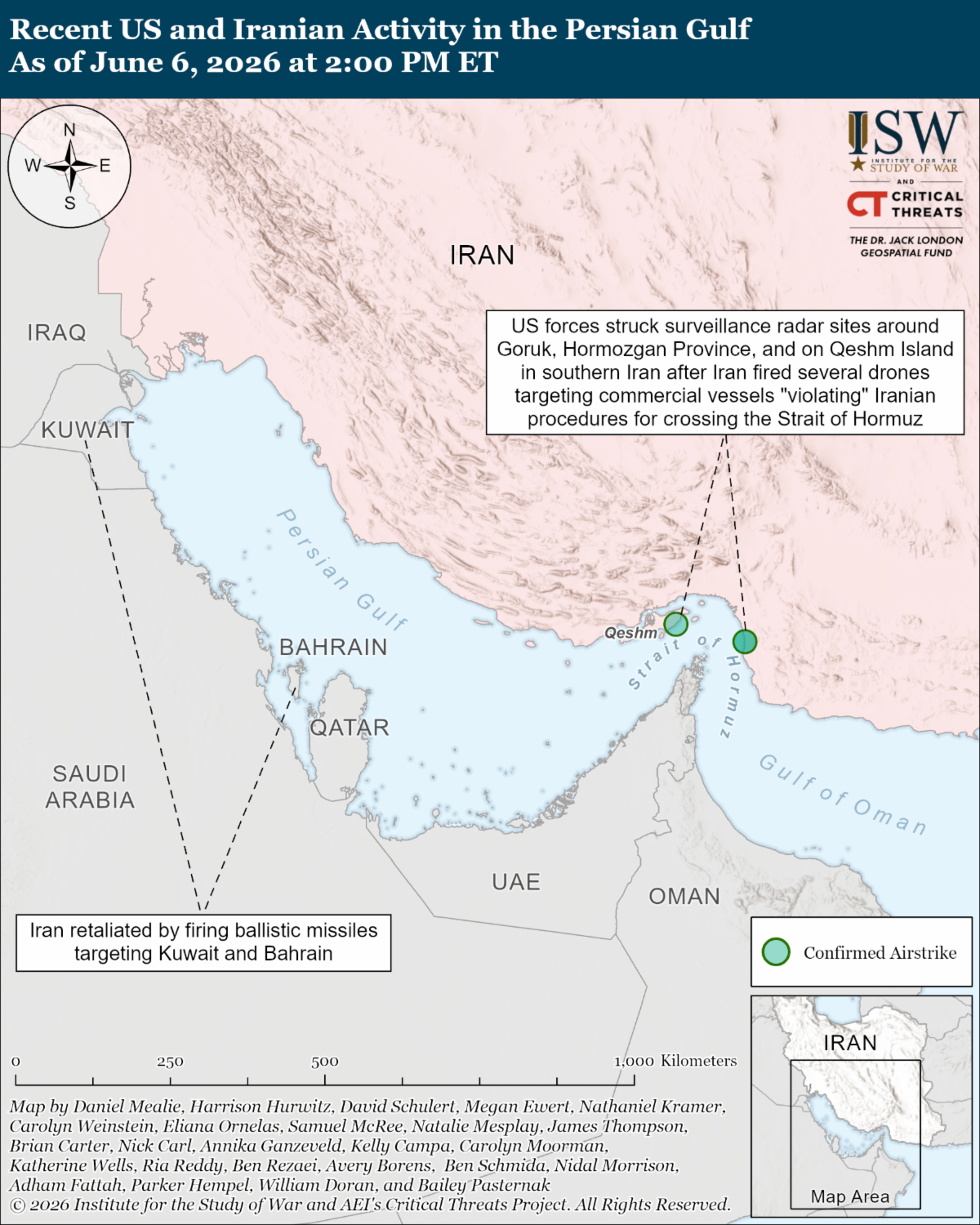
Iran has continued to use force to impose its illegal traffic separation scheme, which is prompting US responses to prevent Iran from using force to impose its illegal traffic separation scheme. The IRGC Public Relations Office claimed on June 5 that four oil tankers attempted to violate Iran’s illegal traffic separation scheme under US military “guidance.” It is unclear at this time which vessels Iran targeted or where, but US forces have coordinated the passage of over 100 commercial vessels through the strait over the past month, according to an unspecified US official. The IRGC Navy ”targeted” one vessel with unspecified weapons, and Iranian forces also fired “warning shots” at unspecified “US ships” near Larak Island, according to Iranian state media. US Central Command (CENTCOM) confirmed that it shot down four Iranian drones targeting maritime traffic in the strait. CENTCOM struck Iranian surveillance radar sites on Qeshm Island and in Goruk, Hormozgan Province, in response to the Iranian attacks on commercial vessels. Strikes against these surveillance targets would presumably make it more difficult for Iran to attack commercial shipping in the strait. Iranian forces then launched several missiles targeting US bases in Bahrain and Kuwait on June 5. It is not immediately clear why Iran targeted these specific bases. Kuwaiti forces intercepted seven Iranian missiles, while the Bahraini forces intercepted three missiles and several drones. No casualties were reported. | 




No comments:
Post a Comment