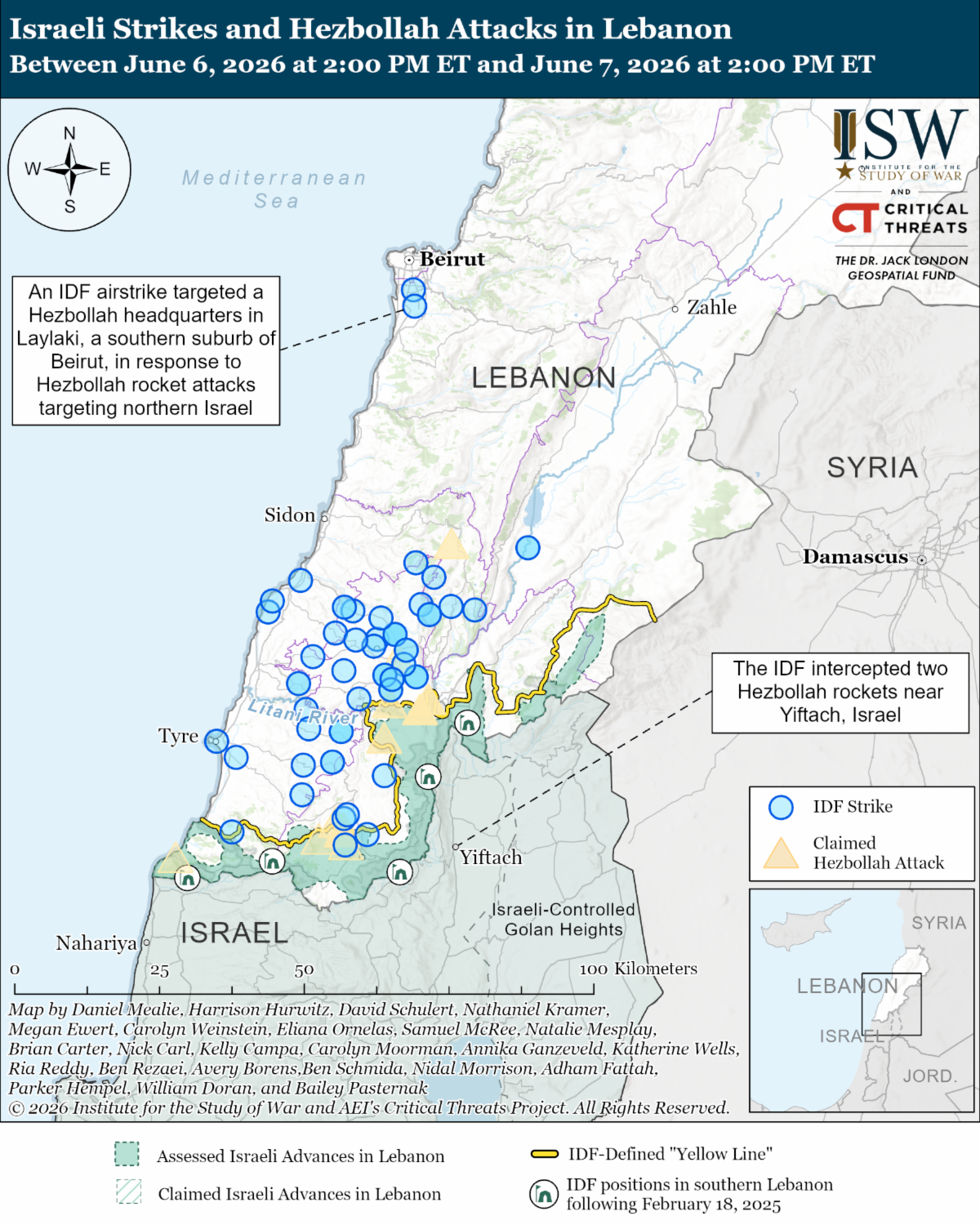
A Hezbollah rocket attack on northern Israel on June 7 is threatening to completely collapse the ceasefire in the Middle East. Israel responded to the Hezbollah attack by conducting an airstrike in Beirut’s southern suburbs. Iran then retaliated against Israel’s strike south of Beirut by firing about 10 missiles at an Israeli airbase. Both the Israeli retaliation against Hezbollah and the Iranian retaliation against Israel were relatively restrained. Hezbollah began this round of escalation on June 7 when it fired a salvo of rockets at northern Israel. These rockets were intercepted near Yiftach. The Israel Defense Forces (IDF) then struck a Hezbollah headquarters in Beirut’s southern suburbs. Senior Israeli officials have been extremely clear about the possible Israeli response to Hezbollah attacks on northern Israel. Netanyahu said on June 1 that the IDF would strike Hezbollah targets in Beirut if Hezbollah continued to attack northern Israel. Israeli media claimed that the IDF is prepared to conduct additional airstrikes in the Beirut area if Israeli political leaders authorize the IDF to expand its operations.
Iran responded with a missile attack designed to deter future Israeli attacks against Hezbollah while avoiding escalation into a resumption of full-scale war. Iran targeted Ramat David Airbase in northern Israel because, according to the Islamic Revolutionary Guards Corps (IRGC), the Israeli aircraft that struck Hezbollah sites in Beirut on June 7 flew their mission from Ramat David. The IRGC fired at least ten missiles. The IDF intercepted all the missiles, and there appear to be no casualties at the time of this writing. The IRGC also threatened to respond with “broader” attacks if Israel continues its operations against Hezbollah. The commander of Iran’s top operational headquarters, the Khatam ol Anbia Headquarters, threatened that Israel must stop attacking southern Lebanon and Beirut and that if Israel expands attacks regionally or responds to Iran’s most recent attack, Israel “will face more crushing and regrettable blows.”
Iran will likely seek to use the threat of a resumption of full-scale war to deter additional Israeli attacks. Iran has almost certainly observed discussions and leaks in Western media about the increasing tension between Trump and Netanyahu over Israeli strikes in Lebanon and Trump’s fears that Israeli actions in Lebanon will cause US-Iran negotiations to collapse, for example. Iran is already attempting to present itself as a reasonable actor in the most recent escalation, even though its ally, Hezbollah, started the escalation on June 7. Supreme Leader Military Adviser Mohsen Rezaei stated on X that Israel “received their response” and that “this response is a warning to stop their evil; any new action will be met with a more crushing response and heavier costs.” | 




No comments:
Post a Comment