Wednesday, June 17, 2026

CORRECTION: Institute for the Study of War - Iran Update Special Report, June 16, 2026


June 16, 2026

Data Cutoff: 2:00 PM ET

Katherine Wells, Ben Rezaei, Carolyn Moorman, and Annika Ganzeveld

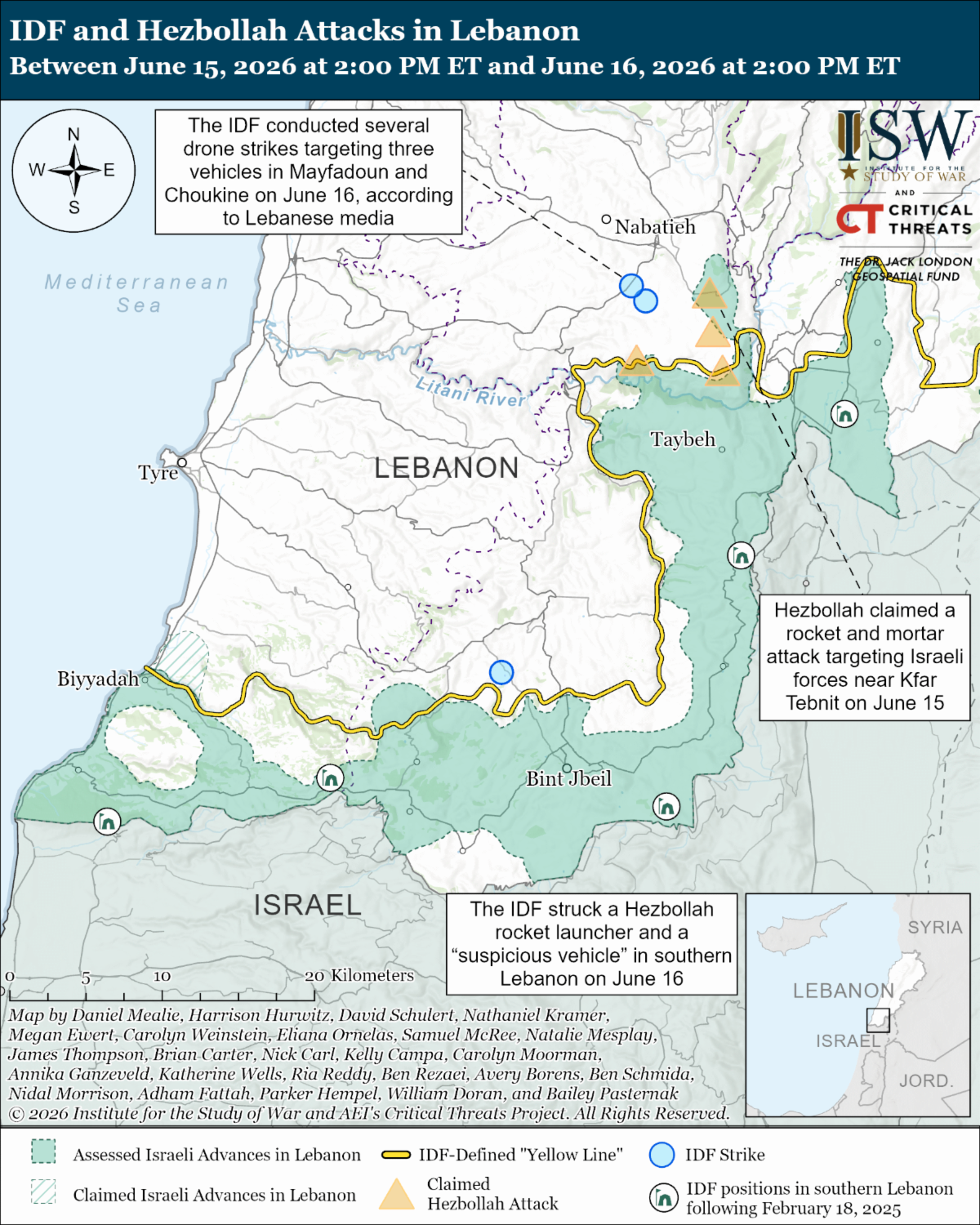
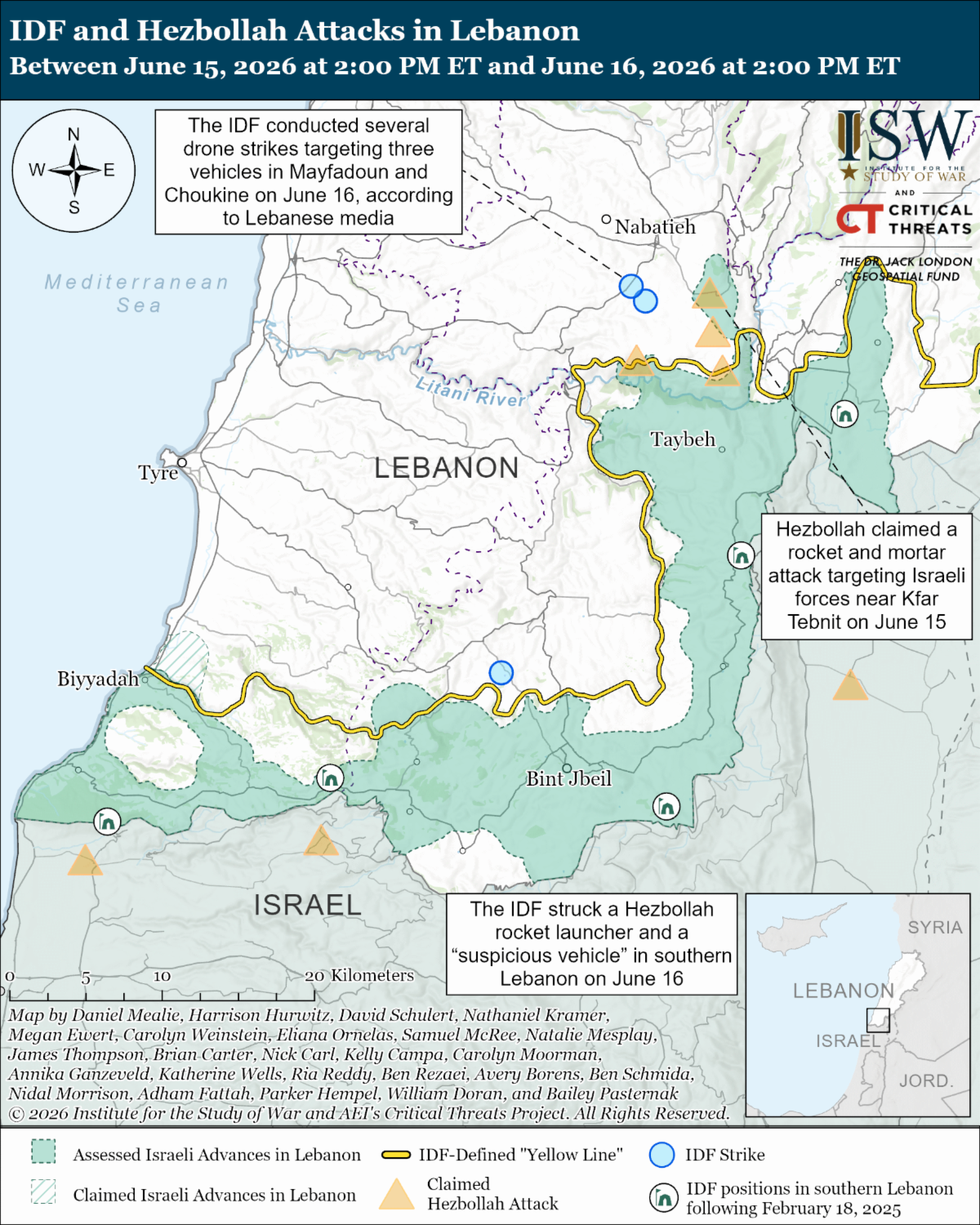
CORRECTION: ISW-CTP has updated the IDF and Hezbollah Attacks in Lebanon map that it published in its Iran Update Special Report last night. A previous version of this map incorrectly depicted that Hezbollah had conducted attacks on northern Israel between 2:00 PM ET on June 15 and 2:00 PM ET on June 16. ISW-CTP did not record any Hezbollah attacks on northern Israel during this time period. We apologize for this error.

TOPLINES

Multiple sources published what appears to be the text of the US-Iran agreement. Neither the United States nor Iran has officially published the text of the agreement at this time. The leaked text of the agreement, if accurate, indicates that Iran has emerged from the conflict in a stronger strategic position, however. Foreign policy analyst Josh Block and Saudi media published an identical version of the US-Iran memorandum of understanding (MoU) on June 16, detailing all 14 clauses of the agreement that the United States and Iran are set to sign in Switzerland on June 19. The text declares that Iran and the United States will conduct further negotiations for 60 days upon signing the MoU, but notes that this negotiation period is “extendable by mutual consent.” Western media outlets such as the Wall Street Journal and Axios corroborated several clauses of the agreement published by Block and Saudi media.


The MoU reportedly grants Iran significant economic relief, which Iran would likely use to try to reconstitute its missile, drone, and nuclear programs, as well as the Axis of Resistance. Block, Saudi media, and the Wall Street Journal reported that the United States will lift its blockade on Iranian ports and waive sanctions on Iranian oil exports and “related services” immediately upon signing the MoU. Axios, citing a source familiar with the text, reported that the United States will “gradually” lift its blockade within 30 days of signing the MoU. Iranian regime outlet Mehr News estimated on June 16 that Iran could generate up to $10 billion USD from just 60 days of oil exports. Iran would likely use immediate economic relief to try to reconstitute its military capabilities, the Axis of Resistance, and its nuclear program. Arab mediators told the Wall Street Journal on June 13 that IRGC Commander Major General Ahmad Vahidi, whom CTP-ISW assesses is dominating regime decision-making, has insisted that Iran's frozen assets should not be “barred from military spending.” Iranian Foreign Affairs Ministry Spokesperson Esmail Baghaei similarly stated in May that Iran would use assets released under a potential agreement with the United States to advance its defense and military sectors, including Iran’s missile and drone programs.  


The MoU states that Iran could receive further economic relief by fulfilling its commitments in the MoU and reaching a final agreement that addresses key nuclear issues. CTP-ISW has not observed any indications that Iranian decision-makers are willing to make concessions on the nuclear issues that would be included in a final agreement, however. Block and Saudi media reported that the United States will release “frozen or restricted” funds and assets “in light of the progress of negotiations towards a final agreement.” US Vice President JD Vance clarified to ABC News on June 15 that the release of frozen assets is contingent upon Iran taking “verified steps” to eliminate its highly enriched uranium (HEU) stockpile. The United States, “together with its regional partners,” will also commit to forming a “rehabilitation and economic development” plan worth at least $300 billion USD, according to the text published by Block, Saudi media, and several Western outlets. An Iranian outlet affiliated with Supreme Leader Military Adviser Mohsen Rezaei similarly reported that the MoU requires the United States and its allies to present a reconstruction plan worth at least $300 billion USD to Iran. US President Donald Trump denied that the United States would give Iran $300 million USD. The economic development plan is contingent upon the United States and Iran reaching a final nuclear agreement that addresses Iran’s HEU stockpile and ability to enrich uranium on Iranian soil, but key Iranian decision-makers, such as Vahidi, have not signaled any willingness to concede on these issues. The current MoU reiterates Iran’s commitment not to produce a nuclear weapon. Iranian officials have historically insisted that Iran does not seek to produce a nuclear weapon, but the regime has nevertheless developed in recent years the latent capability to develop a nuclear weapon if it decided to do so.

KEY TAKEAWAYS

  • Multiple sources published what appears to be the text of the US-Iran agreement. Neither the United States nor Iran has officially published the text of the agreement at this time. The leaked text of the agreement, if accurate, indicates that Iran has emerged from the conflict in a stronger strategic position, however.


  • The MoU reportedly grants Iran significant economic relief, which Iran would likely use to try to reconstitute its missile, drone, and nuclear programs, as well as the Axis of Resistance. The MoU states that Iran could receive further economic relief by fulfilling its commitments in the MoU and reaching a final agreement that addresses key nuclear issues. CTP-ISW has not observed any indications that Iranian decision-makers are willing to make concessions on the nuclear issues that would be included in a final agreement, however.


  • Iran will likely try to exploit the agreement’s seemingly ambiguous language about the Strait of Hormuz to try to enforce its control over shipping through the strait. The reported text of the agreement does not explicitly bar Iran from “managing” the strait, and Iran could therefore continue to insist on vessels using its illegal traffic separation scheme in Iranian territorial waters and paying “fees” to the IRGC Navy.


  • The Iranian regime is interpreting the clause in the agreement about a ceasefire “on all fronts” as a requirement for Israel to cease operations against Hezbollah and withdraw from Lebanon. This interpretation is part of a broader Iranian effort to preserve Hezbollah by trying to secure Israel’s capitulation in Lebanon.


  • The reported MoU terms indicate that Iran structured the agreement in a way to try to limit the United States’ ability to impose renewed pressure on Iran during the 60-day negotiations period and thereby make it more challenging for the United States to extract concessions from Iran during the negotiations.


  • Iranian officials and media are largely framing the US-Iran MoU as an Iranian victory that codifies Iran’s military achievements. The Iranian regime’s English-language media outlet, Press TV, argued on June 16 that the MoU is not simply a ceasefire, but rather represents the “political codification of a battlefield reality.” 

ISW takes no US or foreign government funding.

We are powered by the support of individuals like you.

Help us stay independent and impactful.

Website | Jobs | Internships


Follow ISW on social media:


Facebook | X | YouTube | Instagram | LinkedIn | Threads | Bluesky

© 2026 Institute for the Study of War and AEI’s Critical Threats Project. All rights reserved.


Donate online or by sending a check to the Institute for the Study of War at 1400 16th Street NW, Suite #515, Washington, DC 20036. Please consider including the Institute for the Study of War in your estate plans.


ISW is a tax-exempt organization under section 501(c)(3) of the Internal Revenue Code. Donations are tax-deductible to the extent permitted by law.


ISW is a non-partisan, non-profit, public policy research organization. ISW advances an informed understanding of military affairs through reliable research, trusted analysis, and innovative education. We are committed to improving the nation's ability to execute military operations and respond to emerging threats in order to achieve US strategic objectives.

June 16, 2026

Data Cutoff: 2:00 PM ET

Katherine Wells, Ben Rezaei, Carolyn Moorman, and Annika Ganzeveld

TOPLINES

Multiple sources published what appears to be the text of the US-Iran agreement. Neither the United States nor Iran has officially published the text of the agreement at this time. The leaked text of the agreement, if accurate, indicates that Iran has emerged from the conflict in a stronger strategic position, however. Foreign policy analyst Josh Block and Saudi media published an identical version of the US-Iran memorandum of understanding (MoU) on June 16, detailing all 14 clauses of the agreement that the United States and Iran are set to sign in Switzerland on June 19. The text declares that Iran and the United States will conduct further negotiations for 60 days upon signing the MoU, but notes that this negotiation period is “extendable by mutual consent.” Western media outlets such as the Wall Street Journal and Axios corroborated several clauses of the agreement published by Block and Saudi media.


The MoU reportedly grants Iran significant economic relief, which Iran would likely use to try to reconstitute its missile, drone, and nuclear programs, as well as the Axis of Resistance. Block, Saudi media, and the Wall Street Journal reported that the United States will lift its blockade on Iranian ports and waive sanctions on Iranian oil exports and “related services” immediately upon signing the MoU. Axios, citing a source familiar with the text, reported that the United States will “gradually” lift its blockade within 30 days of signing the MoU. Iranian regime outlet Mehr News estimated on June 16 that Iran could generate up to $10 billion USD from just 60 days of oil exports. Iran would likely use immediate economic relief to try to reconstitute its military capabilities, the Axis of Resistance, and its nuclear program. Arab mediators told the Wall Street Journal on June 13 that IRGC Commander Major General Ahmad Vahidi, whom CTP-ISW assesses is dominating regime decision-making, has insisted that Iran's frozen assets should not be “barred from military spending.” Iranian Foreign Affairs Ministry Spokesperson Esmail Baghaei similarly stated in May that Iran would use assets released under a potential agreement with the United States to advance its defense and military sectors, including Iran’s missile and drone programs.  


The MoU states that Iran could receive further economic relief by fulfilling its commitments in the MoU and reaching a final agreement that addresses key nuclear issues. CTP-ISW has not observed any indications that Iranian decision-makers are willing to make concessions on the nuclear issues that would be included in a final agreement, however. Block and Saudi media reported that the United States will release “frozen or restricted” funds and assets “in light of the progress of negotiations towards a final agreement.” US Vice President JD Vance clarified to ABC News on June 15 that the release of frozen assets is contingent upon Iran taking “verified steps” to eliminate its highly enriched uranium (HEU) stockpile. The United States, “together with its regional partners,” will also commit to forming a “rehabilitation and economic development” plan worth at least $300 billion USD, according to the text published by Block, Saudi media, and several Western outlets. An Iranian outlet affiliated with Supreme Leader Military Adviser Mohsen Rezaei similarly reported that the MoU requires the United States and its allies to present a reconstruction plan worth at least $300 billion USD to Iran. US President Donald Trump denied that the United States would give Iran $300 million USD. The economic development plan is contingent upon the United States and Iran reaching a final nuclear agreement that addresses Iran’s HEU stockpile and ability to enrich uranium on Iranian soil, but key Iranian decision-makers, such as Vahidi, have not signaled any willingness to concede on these issues. The current MoU reiterates Iran’s commitment not to produce a nuclear weapon. Iranian officials have historically insisted that Iran does not seek to produce a nuclear weapon, but the regime has nevertheless developed in recent years the latent capability to develop a nuclear weapon if it decided to do so.

KEY TAKEAWAYS

  • Multiple sources published what appears to be the text of the US-Iran agreement. Neither the United States nor Iran has officially published the text of the agreement at this time. The leaked text of the agreement, if accurate, indicates that Iran has emerged from the conflict in a stronger strategic position, however.


  • The MoU reportedly grants Iran significant economic relief, which Iran would likely use to try to reconstitute its missile, drone, and nuclear programs, as well as the Axis of Resistance. The MoU states that Iran could receive further economic relief by fulfilling its commitments in the MoU and reaching a final agreement that addresses key nuclear issues. CTP-ISW has not observed any indications that Iranian decision-makers are willing to make concessions on the nuclear issues that would be included in a final agreement, however.


  • Iran will likely try to exploit the agreement’s seemingly ambiguous language about the Strait of Hormuz to try to enforce its control over shipping through the strait. The reported text of the agreement does not explicitly bar Iran from “managing” the strait, and Iran could therefore continue to insist on vessels using its illegal traffic separation scheme in Iranian territorial waters and paying “fees” to the IRGC Navy.


  • The Iranian regime is interpreting the clause in the agreement about a ceasefire “on all fronts” as a requirement for Israel to cease operations against Hezbollah and withdraw from Lebanon. This interpretation is part of a broader Iranian effort to preserve Hezbollah by trying to secure Israel’s capitulation in Lebanon.


  • The reported MoU terms indicate that Iran structured the agreement in a way to try to limit the United States’ ability to impose renewed pressure on Iran during the 60-day negotiations period and thereby make it more challenging for the United States to extract concessions from Iran during the negotiations.


  • Iranian officials and media are largely framing the US-Iran MoU as an Iranian victory that codifies Iran’s military achievements. The Iranian regime’s English-language media outlet, Press TV, argued on June 16 that the MoU is not simply a ceasefire, but rather represents the “political codification of a battlefield reality.” 

ISW takes no US or foreign government funding.

We are powered by the support of individuals like you.

Help us stay independent and impactful.

Website | Jobs | Internships


Follow ISW on social media:


Facebook | X | YouTube | Instagram | LinkedIn | Threads | Bluesky

© 2026 Institute for the Study of War and AEI’s Critical Threats Project. All rights reserved.


Donate online or by sending a check to the Institute for the Study of War at 1400 16th Street NW, Suite #515, Washington, DC 20036. Please consider including the Institute for the Study of War in your estate plans.


ISW is a tax-exempt organization under section 501(c)(3) of the Internal Revenue Code. Donations are tax-deductible to the extent permitted by law.


ISW is a non-partisan, non-profit, public policy research organization. ISW advances an informed understanding of military affairs through reliable research, trusted analysis, and innovative education. We are committed to improving the nation's ability to execute military operations and respond to emerging threats in order to achieve US strategic objectives.

No comments:

Post a Comment