The United States and Iran reached an agreement on June 14 that apparently calls for a ceasefire on all fronts, Iran to “open” the Strait of Hormuz, and the United States to lift its naval blockade on Iranian ports. US President Donald Trump announced on Truth Social that he “fully authorize[s] the toll-free opening of the Strait of Hormuz” and “authorize[s] the immediate removal of the United States Naval blockade.” Iran’s top national security decision-making body, the Supreme National Security Council (SNSC), and Deputy Foreign Affairs Minister Kazem Gharibabadi announced that Iranian officials agreed to a final draft of the memorandum of understanding (MOU) after 15 hours of meetings with Qatari officials. The SNSC and Gharibabadi confirmed the ceasefire on all fronts and that the United States will lift its blockade, but notably did not comment on whether Iran would re-open the strait without tolls. Both Trump and Gharibabadi said that the United States and Iran will sign the agreement with the other parties in Switzerland on June 19. Gharibabadi said that both parties will discuss “termination of all sanctions” on Iran, the nuclear issue, and ”economic reconstruction and development” in Iran in the 60 days after the agreement is signed. Pakistani Prime Minister Shehbaz Sharif noted that the mediators will conduct several meetings this week ahead of the signing ceremony and to ”lay the foundation for technical talks.”
The exact terms of the MoU are not publicly available as of this writing, which makes it difficult to assess how Iran views the agreement in terms of achieving Iranian objectives. Iran’s strategic objectives at this time include solidifying control over the Strait of Hormuz and bolstering the Axis of Resistance. It is not clear if a “toll-free” and “open” strait means that Iran retains any of its management functions over the strait. Iranian Foreign Affairs Minister Abbas Araghchi has, for example, said that Iran is committed to a “toll-free” strait but will still impose fees. It is unclear if Iran will keep regulating traffic or its coercive activities in the strait, or if Iran made commitments not to disrupt shipping through the strait in the future. Iran has repeatedly emphasized that the strait is under Iranian and Omani control and that the strait is an important leverage in Iran’s broader deterrence strategy. Iranian statements regarding the contents of previous MOU drafts indicate that some terms of the agreement are at odds with stated US positions on the Strait of Hormuz in recent months, especially with regard to what constitutes an “open strait.” An “open” strait under Iranian management is not a return to the pre-war status quo and would mean that Iran has accomplished a key war aim.
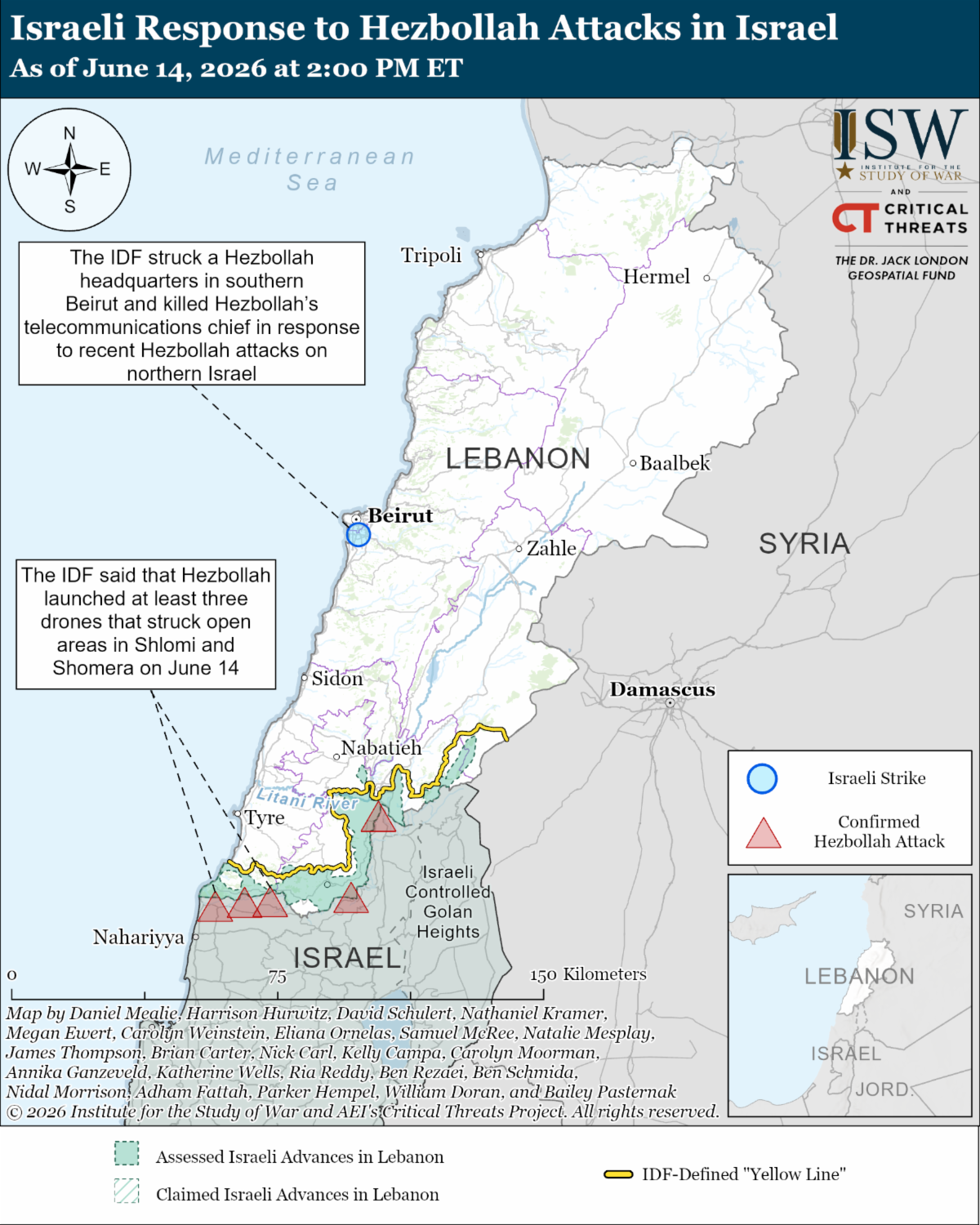
An Israeli attack in southern Beirut prompted a flurry of diplomatic efforts to reach an agreement amid Iranian threats that it would respond by attacking Israel. The IDF struck a Hezbollah headquarters in Dahiyeh, Hezbollah’s stronghold in Beirut’s southern suburbs, and killed Hezbollah’s telecommunications chief on June 14. Israel conducted the attack in response to several recent Hezbollah drone attacks that landed in northern Israel. Israel has repeatedly warned since June 1 that it would strike Hezbollah targets in Beirut’s vicinity if Hezbollah conducted attacks in northern Israel. Hezbollah likely continued to attack northern Israel despite Israeli threats in order to impose costs on Israel for its current presence in southern Lebanon and force an IDF withdrawal. Hezbollah has historically used attacks targeting northern Israel as a means through which it can impose costs and influence Israeli decision-making. This tactic, along with attacks targeting Israeli soldiers in southern Lebanon, was a key element of Hezbollah’s efforts to force Israel’s withdrawal from Lebanon in 2000. Iran, in turn, has pledged to respond to any Israeli attack on Dahiyeh with Iranian strikes on Israel in order to deter Israeli attacks that could degrade Hezbollah. | 


No comments:
Post a Comment