Iranian statements regarding the contents of the US-Iran memorandum of understanding (MoU) indicate that some terms of the agreement are at odds with stated US positions on the Strait of Hormuz in recent months. Iranian Foreign Affairs Minister Abbas Araghchi discussed the contents of the MoU in an interview on Iranian state media on June 12. Araghchi said that the MoU could change until the agreement is signed. The agreement has two parts: a first stage that deals with an “end to the war” on all fronts, a resumption of traffic in the Strait of Hormuz, and economic benefits for Iran, including reconstruction funds, sanctions relief, release of frozen funds, and an end to the US blockade. The second stage would deal with the nuclear issue and “one or two other [unspecified] issues.” Araghchi discussed the strait at length and noted that it is under Iranian and Omani sovereignty and that both countries will collect fees after the MoU. Iran will also manage the strait. Araghchi rejected the term “tolls” but defended Iran charging “service“ fees for passage through the strait, which is effectively an attempt to rebrand Iran’s protection racket as legal administration. Araghchi added that Iran would provide safe passage through the strait for civilian vessels but create separate arrangements for military vessels. This system of management is at odds with both US policy and long-established maritime legal precedence. US President Donald Trump has repeatedly said, for example, that the strait must be open with no fees or Iranian management. A US official told Reuters that the agreement would “open” the strait, but an “open” strait under Iranian management would be very detrimental to US interests, as ISW-CTP has previously argued. An “open” strait under Iranian management is not a return to the pre-war status quo and would mean that Iran has accomplished a key war aim.
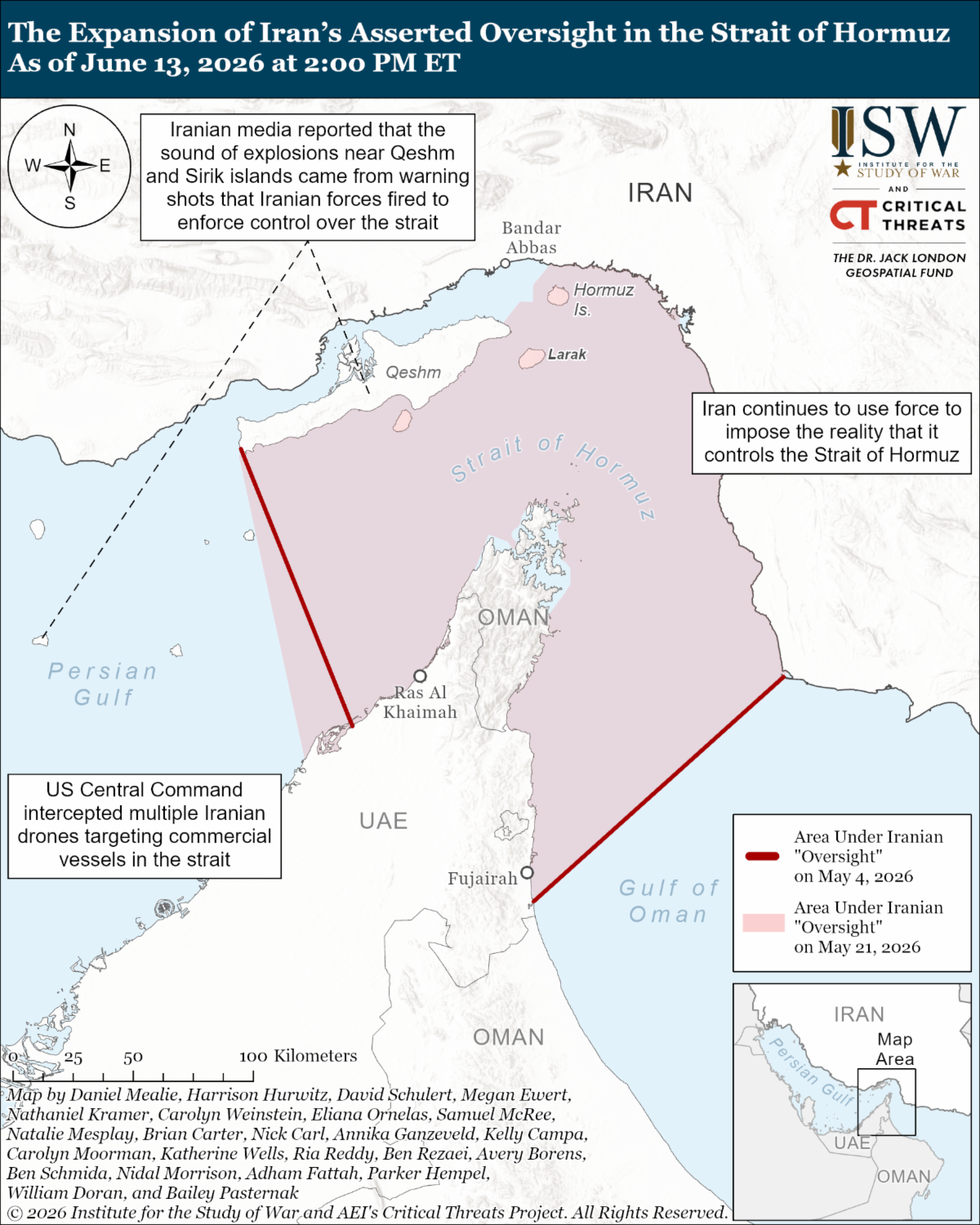
Iran also continues to use force in an attempt to impose the reality that it controls the Strait of Hormuz. US Central Command (CENTCOM) reported on June 12 that US forces intercepted multiple Iranian drones targeting commercial vessels in the strait. Iranian media separately reported explosions near Qeshm and Sirik islands and said the sounds came from warning shots that Iranian forces fired to enforce control over the strait.
Other issues—like when Iran can access frozen funds and how much it will be able to access—remain an issue in negotiations as well. Iranian media reported on June 13 that Iran proposed releasing half of its frozen assets early and the rest in a final agreement, but the United States rejected this offer. Qatar then reportedly proposed a $12 billion USD package, including $6 billion USD in Iranian assets in Qatar for humanitarian use and a separate $6 billion USD credit line that Iran would direct. Iran and Qatar reportedly initiated two MoUs during Araghchi and Parliament Speaker Mohammad Bagher Ghalibaf‘s visit to Doha on May 25, but the MoUs remain unsigned and depend on a final US-Iran agreement. Trump separately stated on June 13 that “no money will exchange hands,” which conflicts with Iranian demands for the release of its frozen assets. | 


No comments:
Post a Comment