US and Iranian sources have expressed diverging interpretations of some key aspects of the recent US-Iran agreement. The full text of the agreement has not yet been published, which makes it difficult to ascertain which interpretations of the agreement are accurate. The United States and Iran reached an agreement on June 14 to end the war and are expected to formally sign the agreement in Geneva on June 19. The agreement reportedly calls for a ceasefire on all fronts, requires Iran to “open” the Strait of Hormuz, and requires the United States to lift its naval blockade on Iranian ports. US and Iranian officials have stated that additional negotiations, including discussions over Iran’s nuclear program, will occur during the 60 days following the agreement’s signing. US Vice President JD Vance stated on June 15 that the United States expects the strait to be open “in a toll-free way for the long term.” Islamic Revolutionary Guards Corps (IRGC)-affiliated media, by contrast, reported on June 15 that Iran will pause imposing “fees” on vessels transiting through the strait for the next 60 days but intends to resume charging vessels “service fees” after the 60-day period. Iranian officials have also continued to signal their intent to jointly manage the strait with Oman. US officials have also denied Iranian claims that the agreement will immediately release a portion of Iran’s frozen assets and lift some sanctions. US officials, including US President Donald Trump and Vice President JD Vance, have instead insisted that sanctions relief and the release of Iranian assets are dependent on Iran’s implementation of the agreement. IRGC-affiliated media argued that Iran must “strictly implement its interpretation” of the agreement and disregard the United States’ “nonsense interpretations,” which further highlights the apparent divergence between Iran and the United States’ understandings of the deal. These diverging interpretations of key provisions in the agreement will likely complicate the implementation of the agreement and the next phase of negotiations.
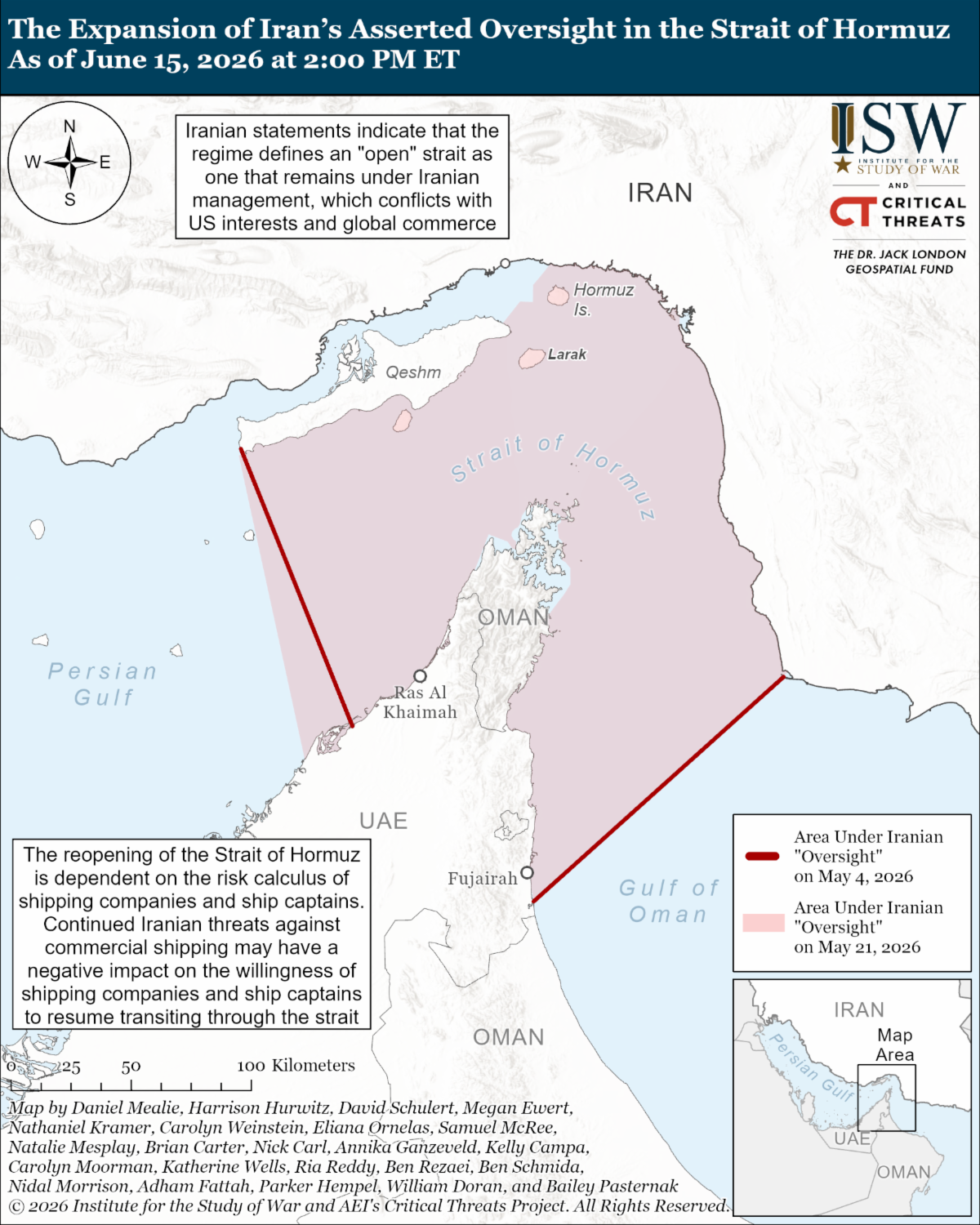
Iran’s interpretation of the agreement’s provisions about the Strait of Hormuz would constitute a significant strategic victory for Iran if its interpretation becomes the recognized reality. Iranian Foreign Affairs Ministry Spokesperson Esmail Baghaei stated on June 15 that Iran and Oman will manage traffic through the strait, provide maritime “services,” and collect related fees. IRGC-affiliated media similarly claimed that the text of the US-Iran agreement was revised to emphasize Iranian and Omani sovereignty over the international waterway. Iranian reports that Iran intends to resume “fee” collection in some capacity are consistent with repeated Iranian claims that these charges are “service fees” rather than transit tolls and therefore do not violate a “toll-free” arrangement. Imposing tolls is one mechanism through which Iran exercises authority over the strait, but ISW-CTP previously assessed that Iran likely prioritizes securing recognized sovereignty over the strait over imposing a toll scheme in the strait. The Iranian regime defines an “open” strait as one that remains under Iranian management, which conflicts with US and global commercial interests. Iranian officials have repeatedly identified control of the strait as a core strategic objective and a central pillar of Iran’s long-term deterrence posture. ISW-CTP previously assessed that Iran likely views control over the strait as essential to restoring deterrence against the United States and Israel following the degradation of its other deterrent capabilities. Any agreement that permits Iran to retain any form of authority over the strait, regardless of whether it imposes tolls or not, would allow Iran to reimpose restrictions in the international waterway at its discretion. Such authority would give Iran significant leverage over global commerce, which Iran could use to extract concessions and advance its strategic objectives.
The reopening of the Strait of Hormuz depends on the risk calculus of shipping companies and ship captains. Continued Iranian threats against commercial shipping may have a negative impact on the willingness of companies and captains to resume transiting through the strait. Trump stated on June 15 that vessels have begun transiting through the strait via the “southern highway,” almost certainly referring to the internationally recognized traffic separation scheme. Shipping companies will likely remain reluctant to resume normal operations, at least for the time being, due to the ongoing risk of Iranian attacks and naval mines, however. The IRGC Navy announced on June 15 that it has not issued transit permits over the past 96 hours and emphasized that the strait remains closed to all vessels. The IRGC Navy reportedly warned ships not to approach areas under Iranian control “until further notice,” which is an implicit threat to attack vessels that attempt to transit through the strait without Iranian permission. These threats are part of a broader Iranian effort since March 2026 to use force to deter vessels from transiting the strait without Iranian authorization. Iran’s mine-laying activities and threats to mine the strait are also a key component of this effort. Reuters, citing shippers in Asia and Europe, reported that shipping companies intend to resume navigation only after authorities fully confirm the safety of the waterway. Reuters, citing Western maritime security services, added that mine-clearing operations could take 40 to 50 days. Trump stated on June 14 that mine-removal operations will begin after the agreement is signed on June 19. Iranian officials and media have not commented publicly on potential mine-clearing efforts. | 


No comments:
Post a Comment