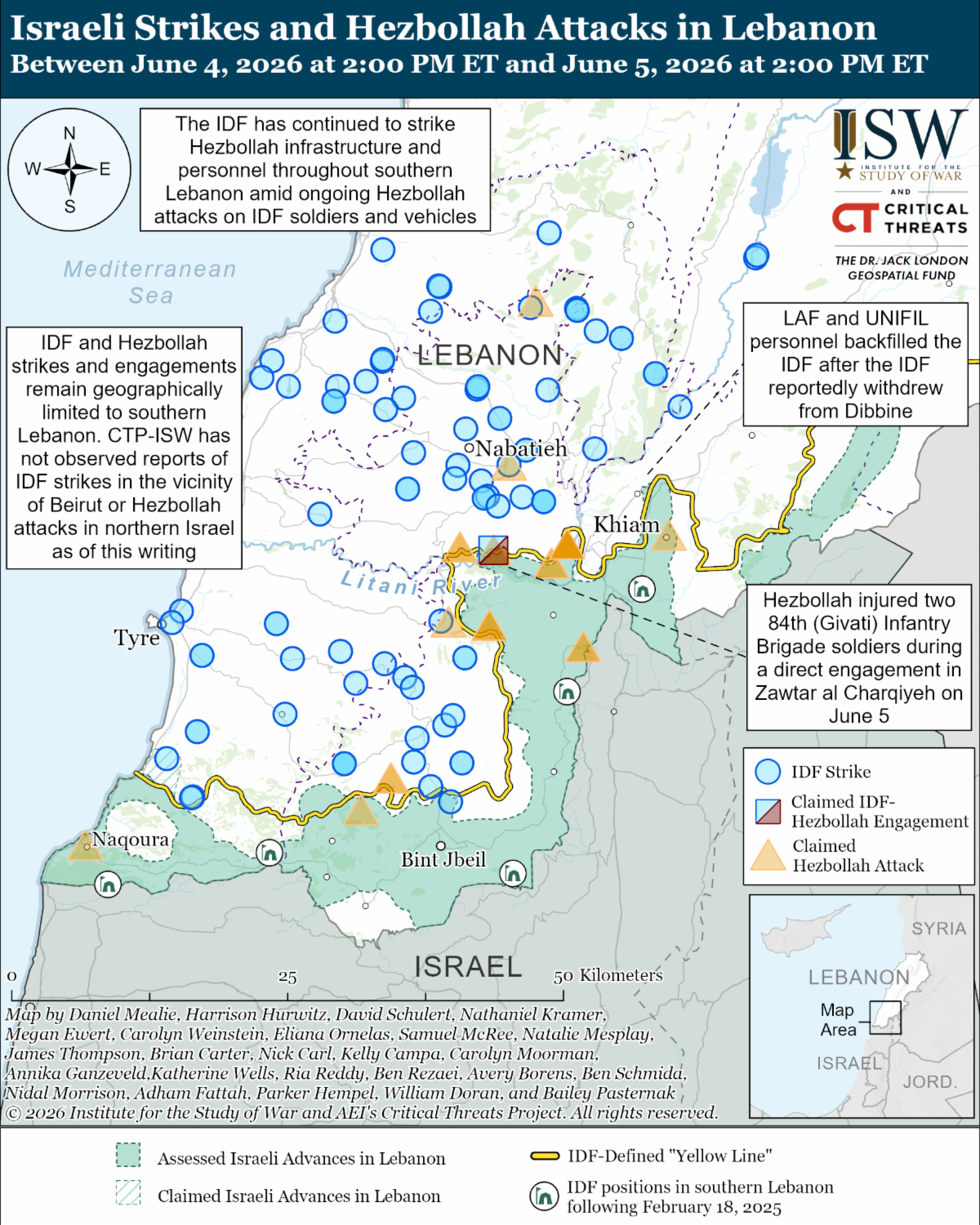
Hezbollah and Iranian leaders continue to reject any ceasefire framework in Lebanon that does not meet their maximalist demand for total Israeli capitulation in Lebanon. Hezbollah officials and allies have continued to reiterate their maximalist demand for a complete ceasefire in Lebanon that would require Israel to cease all military operations and withdraw from Lebanon. Lebanese Parliament Speaker and Hezbollah ally Nabih Berri stated on June 5 that he would agree to Hezbollah’s withdrawal from southern Lebanon if Israeli troops withdrew from the territory they hold in Lebanon and Israel agreed to a “complete and comprehensive ceasefire without conditions.” Berri stated that the June 3 US-Israel-Lebanon agreement is “unjust” and “unworthy of discussion,” which echoes Hezbollah’s rejection of the agreement. The United States, Israel, and Lebanon agreed on June 3 to implement a ceasefire in Lebanon contingent upon Hezbollah’s agreement to halt all attacks and evacuate its fighters south of the Litani River. The Israel Defense Forces (IDF) would halt strikes targeting the group after Hezbollah ceased attacks against Israel and withdrew its forces from south of the Litani. The US and Lebanese governments previously proposed on June 2 that a ceasefire between the IDF and Hezbollah would be geographically limited, with the IDF halting strikes against Beirut in exchange for Hezbollah halting all attacks on Israeli territory. The June 3 agreement did not specify the geographic scope of the proposed ceasefire. Hezbollah and Iranian officials have repeatedly insisted that an acceptable ceasefire must require Israel to halt attacks across Lebanon and withdraw from Lebanese territory. Iranian Foreign Affairs Minister Abbas Araghchi told Hezbollah-affiliated media on June 3 that the IDF must withdraw from territories it has “occupied” in Lebanon as part of an end to the war.
Hezbollah and Iran’s maximalist demands seek to undermine US and Lebanese government efforts to end the conflict with Israel and restrict weapons to the Lebanese state. Hezbollah and Iran have repeatedly rejected ceasefire proposals mediated and supported by the United States and the Lebanese government, which has complicated ongoing US-mediated Israel-Lebanon negotiations. Lebanese President Joseph Aoun and Prime Minister Nawaf Salam stated on June 5 that Iran is using Lebanon as a bargaining chip in US-Iran negotiations. Salam emphasized that the conflict in Lebanon is “not being fought for us, but on our land and at the expense of our people.” The June 3 US-Israel-Lebanon joint statement suggests that these parties seek to develop a framework to achieve their respective long-term objectives in Lebanon, including ending the conflict in Lebanon and disarming Hezbollah so that weapons are restricted to the Lebanese state. Aoun stated that current Israel-Lebanon negotiations are “tough,” but that the most recent US-Israel-Lebanon joint statement could be a path forward for “lasting peace.”
Iran and Hezbollah continue to link Israeli capitulation in Lebanon to US-Iran negotiations to try to delay discussions about key points of disagreement between the United States and Iran, particularly Iran's nuclear program and its efforts to control the Strait of Hormuz. Araghchi told Hezbollah-affiliated media on June 3 that the US-Iran war will not end until the war in Lebanon ends. Supreme Leader Military Adviser Mohsen Rezaei similarly stated on June 5 that Lebanon is an "inseparable part" of any US-Iran agreement or ceasefire. ISW-CTP previously assessed that Iran is likely trying to use prolonged discussions about a ceasefire in Lebanon to divert attention from negotiations over its nuclear program and activities in the Strait of Hormuz. Iranian officials have repeatedly insisted that Iran will not negotiate on its nuclear program until the United States accepts an initial agreement that includes a complete ceasefire in Lebanon, among other Iranian preconditions. These preconditions likely seek to reduce US leverage ahead of any future nuclear negotiations, which would make it more difficult for the United States to extract nuclear concessions from Iran. Iranian officials have shown no willingness to meet US demands regarding Iran's highly enriched uranium stockpile or enrichment activities. Iran is similarly using the Lebanon issue to shift attention away from its efforts to expand and legitimize its control over the Strait of Hormuz. Iran continues to try to legitimize its illegal actions in the strait and pursue long-term control over this critical waterway, which is detrimental to US and Gulf interests. | 




No comments:
Post a Comment