Tuesday, June 9, 2026

Institute for the Study of War - Iran Update Special Report, June 8, 2026


June 8, 2026

Data Cutoff: 2:00 PM ET

Ria Reddy, Will Doran, Ben Schmida, Adham Fattah, Avery Borens, and Annika Ganzeveld

TOPLINES

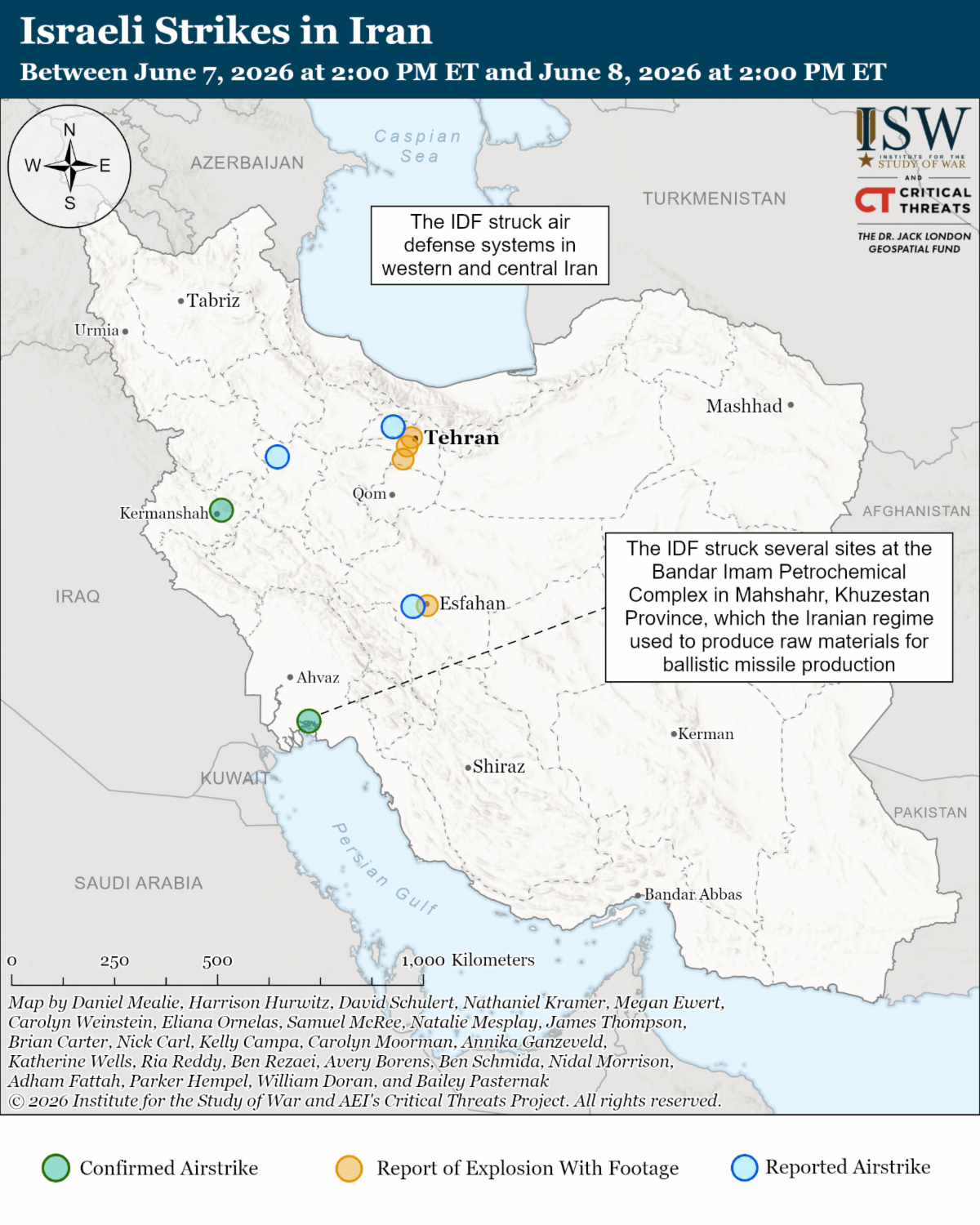
The Iranian regime is attempting to use force and the threat of force to establish a strategic reality in which any Israeli or US attack on an Iranian proxy or partner would result in a large-scale conflict that would seek to impose significant economic and political costs on Israel and the United States. Iran launched missiles at Israel on June 7 following Israeli strikes on a Hezbollah first-person view (FPV) drone headquarters in Beirut’s southern suburbs, which Israel conducted in response to a Hezbollah attack on northern Israel. The Israel Defense Forces (IDF) then struck targets in Iran (see below), after which Iranian forces again launched missiles at Israel. All of the Iranian missiles were intercepted or struck open areas. The Khatam ol Anbia Central Headquarters, which is Iran’s top operational headquarters, subsequently announced the “cessation of [Iranian] armed forces operations” but warned that Iranian forces would inflict “much more severe and crushing measures” if the IDF continued to conduct operations against Hezbollah across Lebanon, including in southern Lebanon. The Khatam ol Anbia Central Headquarters previously threatened on June 1 to attack Israel only if the IDF struck Beirut, which suggests that the regime has since lowered its threshold for attacking Israel. The IDF stated that it will continue to target Hezbollah in southern Lebanon and warned that further attacks on northern Israel would trigger additional strikes on Beirut’s suburbs.


The Iranian regime likely seeks to pressure the United States to limit Israel’s operations against Hezbollah in Lebanon by threatening to conduct large-scale attacks against Israel. The Iranian regime is almost certainly monitoring reports that US President Donald Trump would prefer a negotiated settlement over renewed conflict with Iran. Iran’s threats to inflict “much more severe and crushing measures” therefore likely seek to exploit the United States’ aversion to resuming the war and pressure the United States to convince Israel to halt attacks against Hezbollah. This effort aligns with Iran and Hezbollah’s broader objective of securing Israeli capitulation in Lebanon, particularly through a complete cessation of Israeli operations in Lebanon and the withdrawal of Israeli forces from Lebanese territory.

KEY TAKEAWAYS

  • The Iranian regime is attempting to use force and the threat of force to establish a strategic reality in which any Israeli or US attack on an Iranian proxy or partner would result in a large-scale conflict that would seek to impose significant economic and political costs on Israel and the United States. The recent exchange of fire comes as the Iranian regime appears to be placing renewed emphasis on the importance of the Axis of Resistance, and particularly Lebanese Hezbollah, as a central pillar of Iranian deterrence.


  • The Iranian regime likely seeks to pressure the United States to limit Israel’s operations against Hezbollah in Lebanon by threatening to conduct large-scale attacks against Israel. Hezbollah likely seeks to benefit from Iranian deterrence because Iran’s threat to respond to any Israeli attack against Hezbollah injects uncertainty into Israel’s decision-making process for military operations against Hezbollah.


  • The recent Iranian strikes on Israel and Iran’s renewed emphasis on the Axis of Resistance reflect how the Islamic Revolutionary Guards Corps (IRGC) likely continues to dominate regime decision-making. The regime’s renewed emphasis on Hezbollah and the broader Axis of Resistance, coupled with its lower threshold for direct military conflict, likely reflects Vahidi’s efforts to preserve and reinforce what he likely views as one of Iran’s most valuable forms of deterrence.


  • The IDF responded to the Iranian strikes on northern Israel by attacking Iranian air defense and ballistic missile sites in central and western Iran. Open-source intelligence (OSINT) accounts on X and anti-regime media reported strikes against other Iranian military facilities, including drone storage and production facilities in Tehran and Esfahan provinces, respectively.


  • The Houthis announced on June 8 that they will target Israeli vessels in the Red Sea, but have not yet acted on this threat at the time of this writing. Any Houthi attack on Israeli vessels in the Red Sea would likely seek to impose costs on Israel while remaining below the threshold that would trigger a US response. Houthi attacks on Israeli vessels in the Red Sea would complement Iran’s broader effort to pressure international shipping through the Strait of Hormuz and increase costs on regional and global commerce.


  • The Houthis launched at least two ballistic missiles targeting central Israel on June 8, which is consistent with the group’s “limited” involvement in the current war. The Houthis claimed that they launched a ballistic missile salvo at Tel Aviv and other unspecified areas of central Israel on June 8. The IDF stated that it intercepted one missile while a second missile landed near the Yemeni–Saudi border, according to the Saudi Defense Ministry.

ISW takes no US or foreign government funding.

We are powered by the support of individuals like you.

Help us stay independent and impactful.

Website | Jobs | Internships


Follow ISW on social media:


Facebook | X | YouTube | Instagram | LinkedIn | Threads | Bluesky

© 2026 Institute for the Study of War and AEI’s Critical Threats Project. All rights reserved.


Donate online or by sending a check to the Institute for the Study of War at 1400 16th Street NW, Suite #515, Washington, DC 20036. Please consider including the Institute for the Study of War in your estate plans.


ISW is a tax-exempt organization under section 501(c)(3) of the Internal Revenue Code. Donations are tax-deductible to the extent permitted by law.


ISW is a non-partisan, non-profit, public policy research organization. ISW advances an informed understanding of military affairs through reliable research, trusted analysis, and innovative education. We are committed to improving the nation's ability to execute military operations and respond to emerging threats in order to achieve US strategic objectives.

No comments:

Post a Comment