Friday, May 22, 2026

Institute for the Study of War - Iran Update Special Report, May 22, 2026


May 22, 2026

Data Cutoff: 2:00 PM ET

Ben Rezaei, Carolyn Moorman, Ria Reddy, and Brian Carter 

As the Middle East crisis evolves, ISW urgently needs your support.

Help us stay independent and impactful.

TOPLINES

The US-Iran negotiations have reportedly made “slight progress,” but Iran’s highly enriched uranium (HEU) and the Strait of Hormuz remain the two key sticking points in negotiations. It is unclear from public reporting where specifically “progress” was made. An unspecified senior Iranian source told Reuters that both sides have narrowed gaps between their demands, but that Iran’s uranium enrichment and the Strait of Hormuz remain sticking points. An unspecified Pakistani diplomatic source told Saudi news media outlet Al Hadath that the main obstacle in the talks remains how to handle Iran’s HEU, and that closing gaps will not be easy because both sides maintain “high demands.” US Secretary of State Marco Rubio similarly stated that talks show “slight progress” but stressed again that Iran cannot obtain a nuclear weapon or remain in control of the Strait of Hormuz. Iran has not signaled willingness to meet US demands to secure its HEU stockpile out of Iran, and there is a broad consensus in Tehran that Iran must retain control over the strait. US officials have called an outcome wherein Iran continues to control the strait “unfeasible.” Rubio warned that the president has “other options” if negotiations fail.


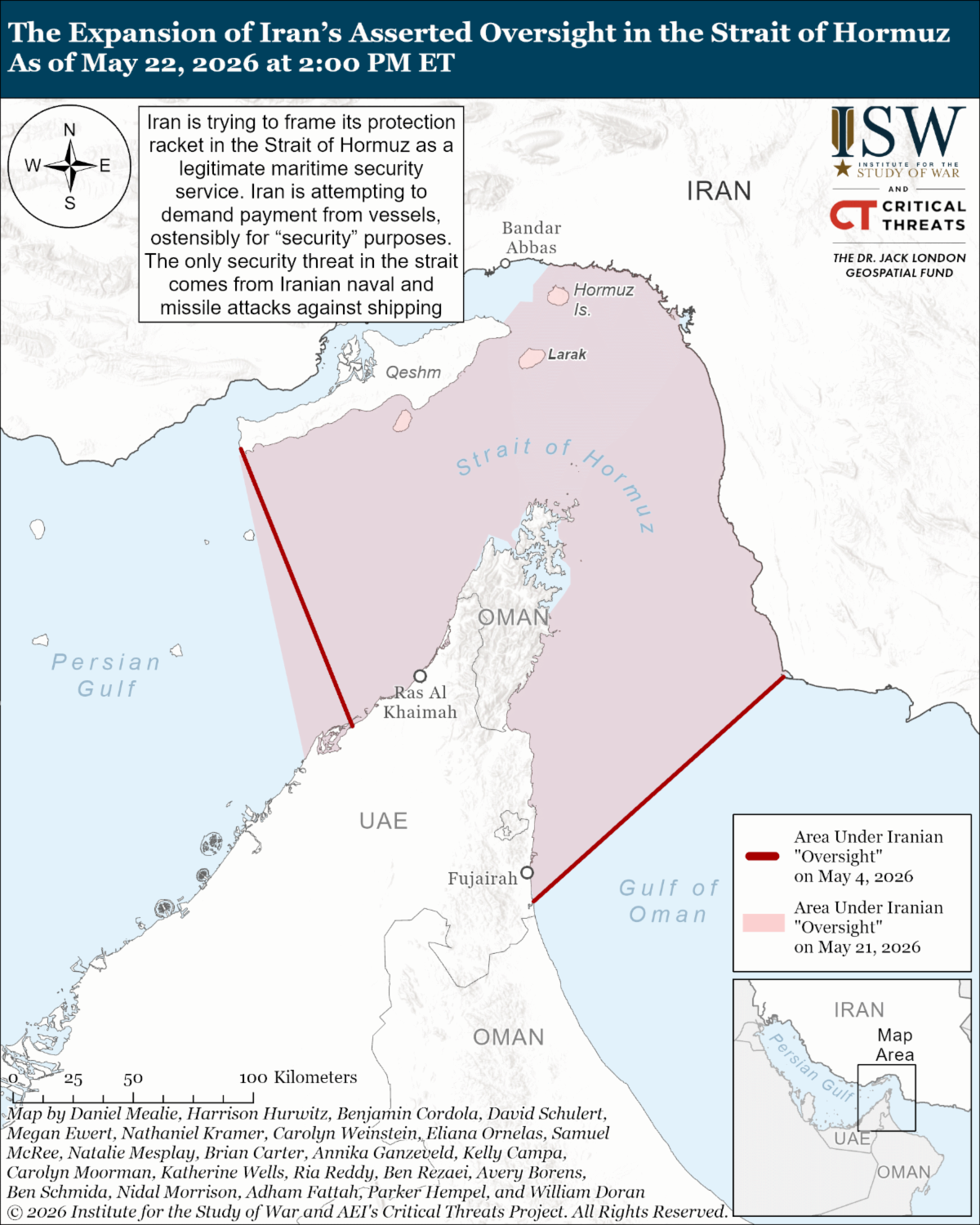
Iran has launched an information operation to frame its protection racket in the Strait of Hormuz as a legitimate maritime security service. Iran’s conduct toward commercial shipping in the Strait of Hormuz is a protection racket, which is a coercive extortion scheme in which an actor creates or threatens danger and then demands payment or compliance in exchange for protection from that danger. The New York Times reported on May 21 that Iran and Oman have discussed a system to charge vessels fees for maritime “services” rather than tolls for passage. Iran likely seeks Omani support to legitimize its efforts to extend control over the entire strait. Iran's current “control” scheme makes territorial claims that infringe upon Emirati and Omani sovereignty. The inclusion of Oman and not the UAE is notable in this context because Omani participation would legitimize Iranian efforts while still extending Iranian claims of sovereignty over Emirati territorial waters. The New York Times reported on May 21 that Oman initially rejected a partnership with Iran but added that Omani officials are now signaling willingness to use Oman’s influence with Gulf neighbors and the United States to support the proposed fee system. A fee and control system under which Iran and Oman control the strait together would still infringe upon Emirati sovereignty. Iran has claimed that its fee is in part for “security” or “insurance” for vessels that transit the strait. The Islamic Revolutionary Guards Corps (IRGC) Navy claimed on May 22 that 35 vessels transited the strait in the past 24 hours after obtaining Iranian “permission” and “security.” This “security” is effectively protection from attacks by Iranian forces, which is the only force that has threatened shipping in the Strait of Hormuz since February 2026. The US Navy, by comparison, is imposing a blockade upon Iranian ports—not the Strait of Hormuz. Commercial vessels only require such security guarantees to transit the strait because Iran has created insecurity through attacks, threats, and restrictions on international shipping. Iran now seeks to require vessels to secure Iranian permission and pay fees in exchange for protection from Iranian attacks or the denial of passage. Bloomberg reported that vessels dealing with Iran’s new Persian Gulf Strait Authority have sometimes received payment requests of up to $2 million for safe passage, though Reuters reported on May 20 that most ships pay around $150,000.

KEY TAKEAWAYS

  • The US-Iran negotiations have reportedly made “slight progress,” but Iran’s highly enriched uranium (HEU) and the Strait of Hormuz remain the two key sticking points in negotiations. It is unclear from public reporting where specifically “progress” was made.


  • Iran has launched an information operation to frame its protection racket in the Strait of Hormuz as a legitimate maritime security service. The Islamic Revolutionary Guards Corps Navy claimed on May 22 that 35 vessels transited the strait in the past 24 hours after obtaining Iranian “permission” and “security.” This “security” is effectively protection from attacks by Iranian forces, which is the only force that has threatened shipping in the Strait of Hormuz since February 2026.


  • The war cannot end in a way that secures US and allied interests until Iran abandons its effort to control the strait. Recognition or compliance with Iranian transit rules would allow the regime to achieve de facto control over the strait.

Website | Jobs | Internships


Follow ISW on social media:


Facebook | X | YouTube | Instagram | LinkedIn | Threads | Bluesky

© 2026 Institute for the Study of War and AEI’s Critical Threats Project. All rights reserved.


Donate online or by sending a check to the Institute for the Study of War at 1400 16th Street NW, Suite #515, Washington, DC 20036. Please consider including the Institute for the Study of War in your estate plans.


ISW is a tax-exempt organization under section 501(c)(3) of the Internal Revenue Code. Donations are tax-deductible to the extent permitted by law.


ISW is a non-partisan, non-profit, public policy research organization. ISW advances an informed understanding of military affairs through reliable research, trusted analysis, and innovative education. We are committed to improving the nation's ability to execute military operations and respond to emerging threats in order to achieve US strategic objectives.

No comments:

Post a Comment