Iran’s latest counterproposal does not appear to meet US demands. Reuters reported on May 18 that Iran sent a new proposal with similar terms to proposals previously rejected by the United States. A senior US official and source briefed on the matter told Axios on May 18 that Iran’s counterproposal does not contain a commitment “about suspending uranium enrichment or handing over its existing stockpile of highly enriched uranium (HEU).” The US official added that the Trump Administration believes Iran’s proposal is ”insufficient.” Islamic Revolutionary Guards Corps (IRGC)-affiliated media reported on May 18 that ”major disagreements” remain between the United States and Iran and stated that Iran would never agree to ”an end to the war in return for nuclear commitments.” US demands have been and continue to be that Iran must give its HEU to the United States, dismantle its nuclear facilities, and pause uranium enrichment for at least 20 years.
US President Donald Trump announced on Truth Social on May 18 that he canceled a scheduled US military strike against Iran that was planned for May 19. Trump stated that Qatari Emir Sheikh Tamim bin Hamad al Thani, Saudi Crown Prince Mohammed bin Salman, and Emirati President Mohamed bin Zayed asked him to suspend the strike “for two or three days” due to ongoing negotiations. A US official and an unspecified source told Axios that the three Gulf leaders warned that they would ”pay the price“ if the United States conducted new strikes on Iran and expressed concerns that Iran would retaliate by targeting their energy and oil infrastructure. Trump noted that the Gulf leaders believe that the United States and Iran can reach a deal that is “very acceptable to the United States” and that would prevent Iran from obtaining nuclear weapons. Trump added that he instructed US Defense Secretary Pete Hegseth, US Chairman of the Joint Chiefs of Staff General Dan Caine, and the US military to remain prepared to launch a “full, large-scale assault” against Iran on short notice if negotiations fail.
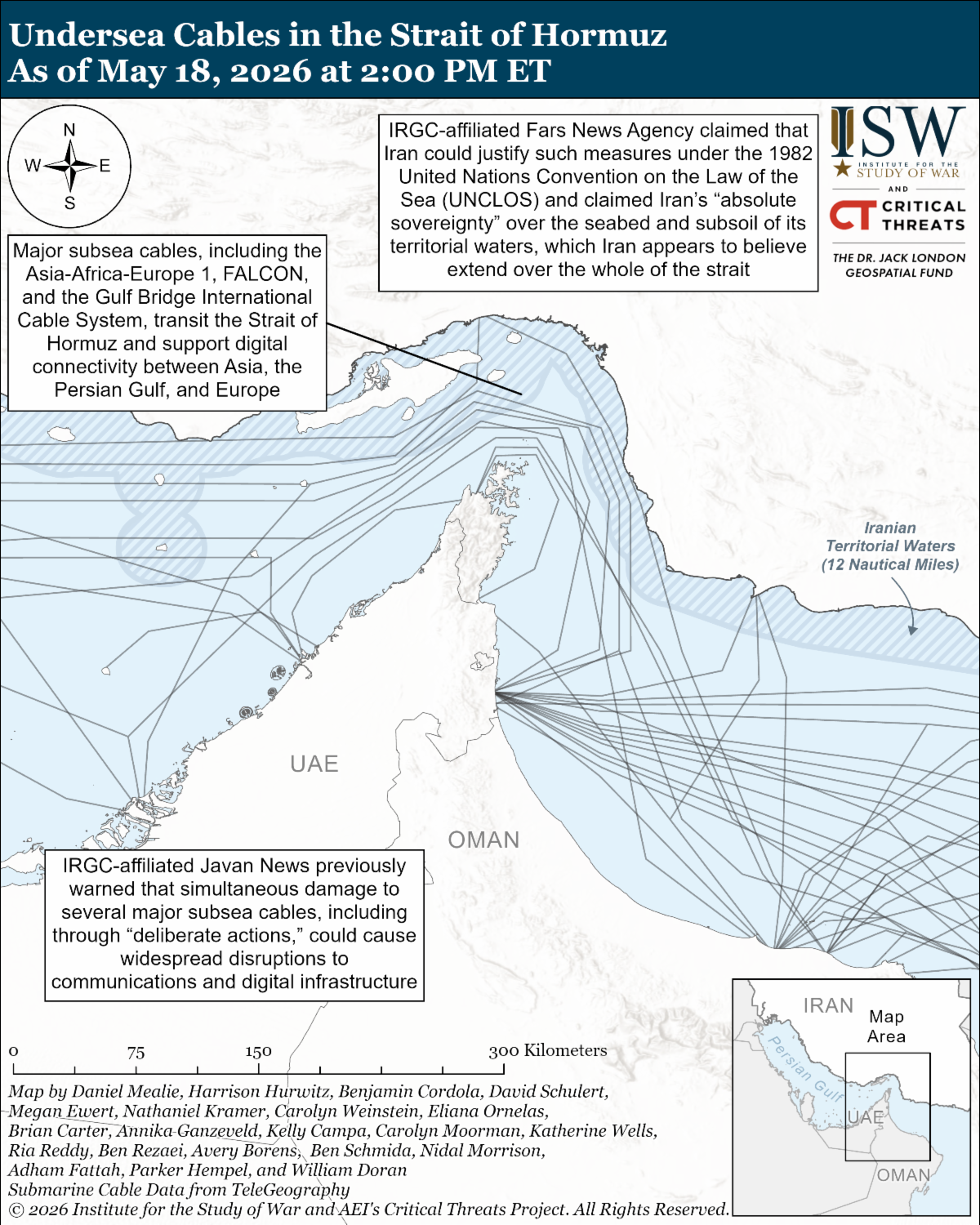
Iran continues to formalize and institutionalize its claimed control over transit through the Strait of Hormuz in contravention of the UN Charter on the Law of the Sea (UNCLOS). The newly established Persian Gulf Strait Authority (PGSA) stated on X on May 18 that it serves as the “legal institution and representative authority” of the Iranian regime for managing transit through the strait. Iran has incorrectly asserted that this is ”legal” under the UNCLOS because the Strait of Hormuz is within Iran’s territorial waters. Article 37 of the UNCLOS states that straits ”used for international navigation between one part of the high seas or an exclusive economic zone and another part of the high seas or an exclusive economic zone” are international straits. Article 38 guarantees that ”all ships and aircraft enjoy the right of transit passage” through such straits, and Article 44 prohibits bordering states--like Iran--from ”hampering” or suspending passage. | 



No comments:
Post a Comment