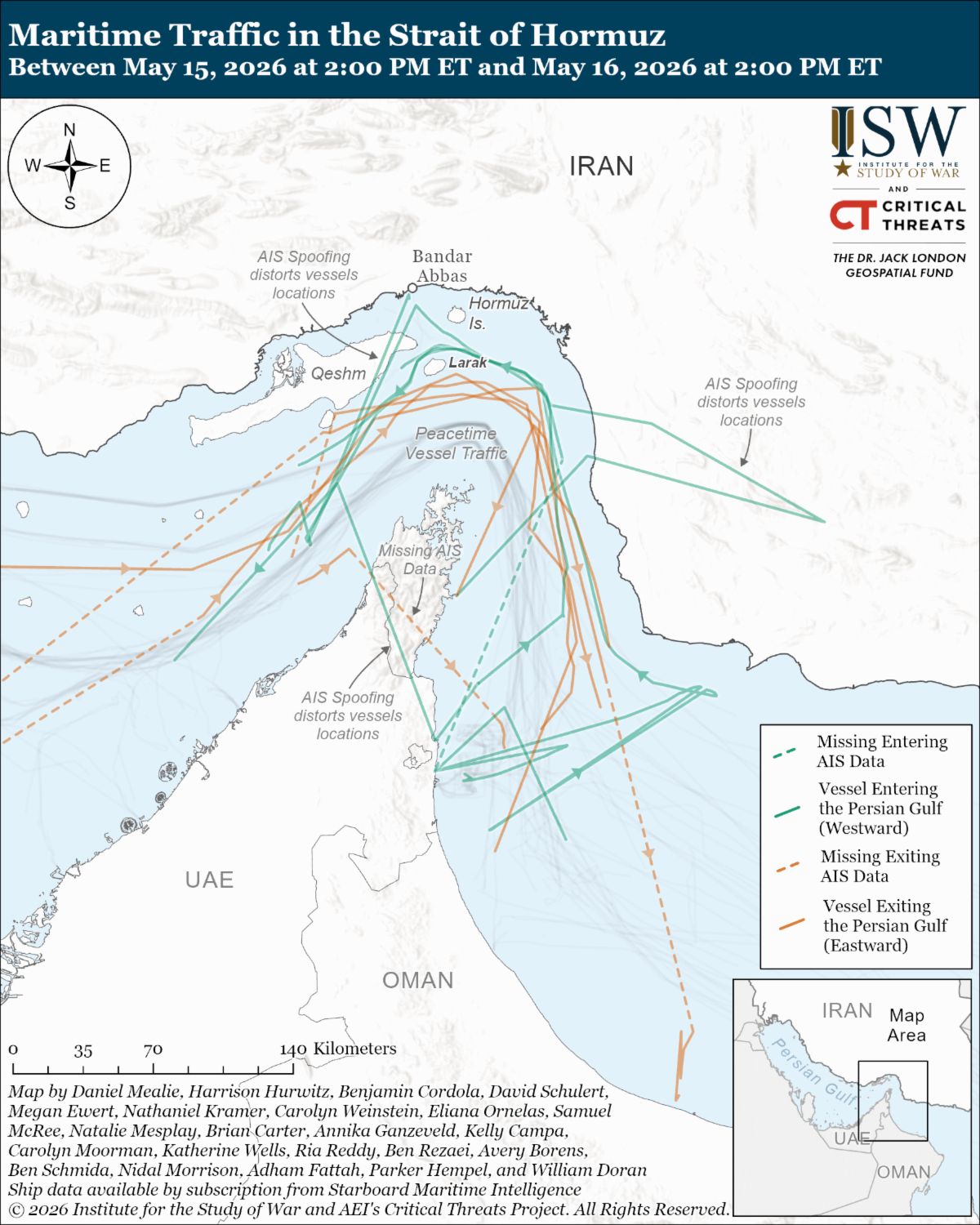
The Iranian regime is introducing a formalized toll system under the guise of maritime insurance policies and continuing to deploy incentives and threats to vessels in the Persian Gulf as part of their efforts to normalize and solidify Iranian control over the strait. This system appears designed to be more palatable than an outright “toll” by framing it as a “maritime insurance policy.” The insurance presumably insures the vessel against an Iranian attack. Iran’s Economy Ministry is pursuing a new scheme to force shipping companies to pay “verifiable insurance policies,” according to a document viewed by Islamic Revolutionary Guards Corps (IRGC) affiliated media outlet Fars on May 16. Iranian Parliament National Security Committee Chairman Ebrahim Azizi also stated on May 16 that Iran has prepared a “professional mechanism” to manage traffic along Iran’s designated route “within the framework of its [Iranian] national sovereignty while guaranteeing international trade security.” Azizi said that the details of the plan will be revealed soon. Azizi’s comments are consistent with the document that Fars cites. Iran would collect fees for unspecified “specialized services” as part of the scheme that Azizi described. These ”specialized services” may be ”insurance.” Azizi clarified that “only commercial vessels and parties cooperating with Iran” would benefit from the new mechanism, which likely means countries that cooperate with Iranian protocols and have ”friendly” or ”non-hostile” relations with Iran. The IRGC Navy is permitting the passage of ships from East Asian countries such as the People’s Republic of China (PRC), Japan, and Pakistan, according to Iranian state media on May 16. Iranian regime media also reported that the IRGC Navy has begun negotiations with unspecified European actors for passage through the strait.
Access would remain restricted for actors associated with the US-led Project Freedom, however, which demonstrates that Iran seeks to retain the ability to coerce other states into adopting policies palatable to Iran by withholding access to the strait. The United States launched Project Freedom to secure traffic through the internationally recognized traffic separation scheme in the strait. US President Donald Trump temporarily paused Project Freedom on May 5 amid ongoing negotiations with Iran.
Iran continues to employ both incentives and threats in order to solidify its control over the strait. The Iranian Port and Maritime Organization announced on May 6 that it would provide fuel, medical, and mechanical assistance to vessels operating in regional and Iranian waters. Armed Forces General Staff-run outlet Defa Press on May 16 also continued to highlight Iran’s capability to interdict shipping through fast attack craft swarm tactics designed to intimidate larger vessels, however. | 


No comments:
Post a Comment