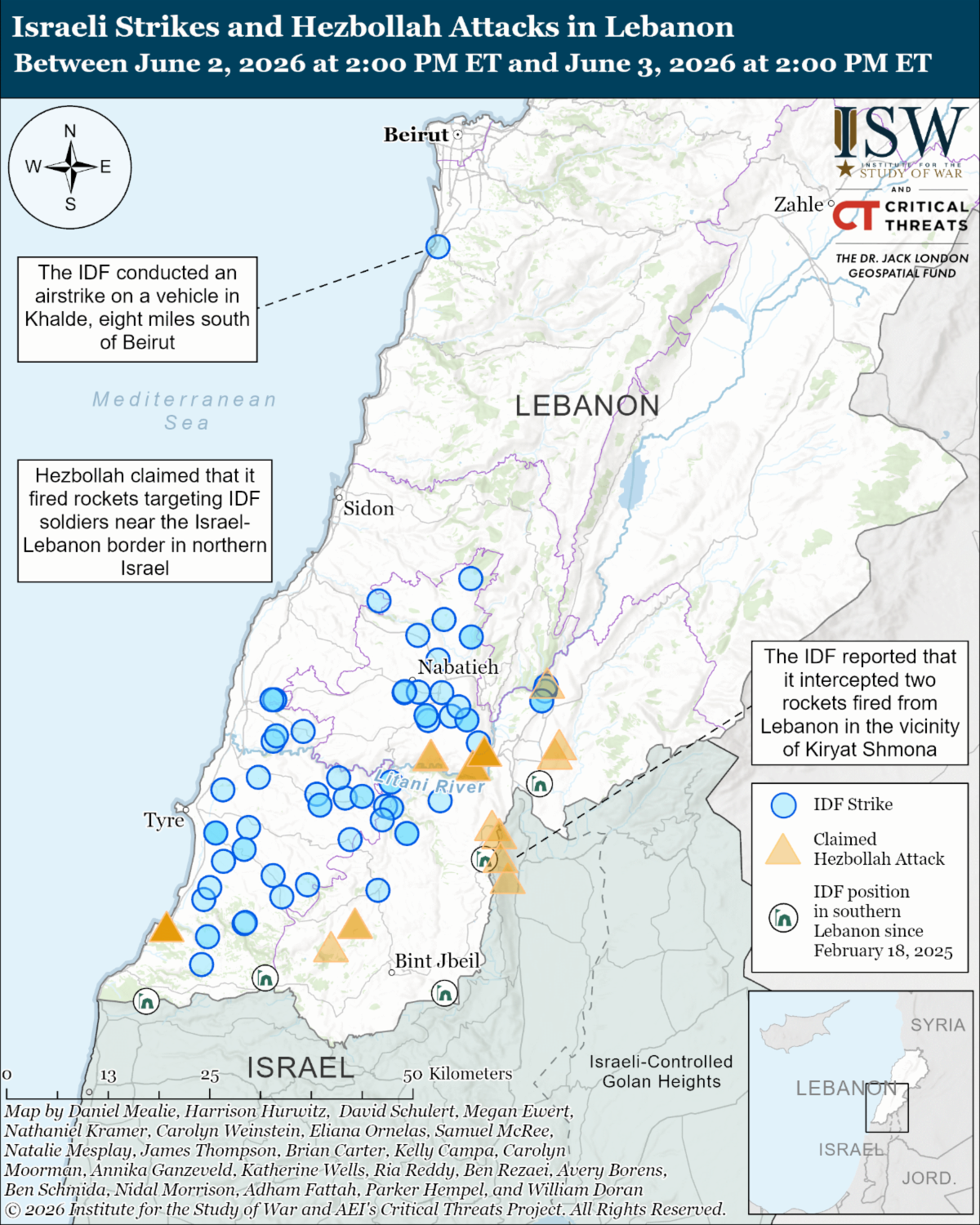
Iran and Hezbollah are continuing to try to transform negotiations about ending the war over the Strait of Hormuz into negotiations about ending the war in Lebanon, which Iran and Hezbollah seek to end in Israel’s capitulation. US President Donald Trump announced on June 1 a partial ceasefire between Israel and Hezbollah in which Israel would not attack Hezbollah targets in Beirut and Hezbollah would halt attacks against Israel. Israeli Prime Minister Benjamin Netanyahu subsequently announced that Israel would attack Hezbollah targets in Beirut if Hezbollah continued to attack Israel, suggesting that he agreed not to strike Beirut if Hezbollah ceased attacks on Israel. The Lebanese Embassy in Washington claimed on June 1 that Hezbollah had agreed to cease attacks on northern Israel. Hezbollah officials claimed after Trump’s announcement that the group would not adhere to a partial ceasefire, however. Hezbollah conducted rocket attacks targeting the Israel Defense Forces (IDF) in northern Israel on June 3 for the first time since June 1. Hezbollah claimed that it fired rockets targeting IDF soldiers near the Israel-Lebanon border on June 3, several hours after the IDF conducted an airstrike targeting a vehicle in Khalde, eight miles south of Beirut. Israeli Ambassador to the United States Yechiel Leiter called Hezbollah’s June 3 attack a violation of the partial ceasefire and suggested that Israel could respond by attacking Hezbollah targets in Beirut. An Israeli military correspondent reported on June 3 that Netanyahu is set to meet with senior Israeli officials to determine Israel’s response to Hezbollah’s attack.
Senior Hezbollah officials have continued to demand a complete ceasefire and the withdrawal of Israeli forces from Lebanon. Hezbollah Political Council member Mahmoud Qamati told Western media that Hezbollah will not accept a partial ceasefire and later said that “there was no ceasefire agreement.” Hezbollah officials have demanded that the IDF cease all military operations in Lebanon and fully withdraw from southern Lebanon and claimed that the group will make “whatever sacrifices are required” to expel Israeli forces from southern Lebanon. A Hezbollah parliamentarian said on June 2 that one of Hezbollah’s primary objectives is to obtain a timeframe for a full Israeli withdrawal from Lebanon. These positions are consistent with Hezbollah Secretary General Naim Qassem’s demands that the IDF halt all operations against Hezbollah and withdraw from Lebanon.
Iranian officials have echoed Hezbollah’s maximalist demands for a complete ceasefire in Lebanon and withdrawal of Israeli forces from Lebanon as part of Iran’s effort to create a protracted discussion about the Lebanon issue and thereby deflect attention from negotiations about the Strait of Hormuz and other key points of disagreement. Iranian Foreign Affairs Minister Abbas Araghchi told Hezbollah-affiliated media on June 3 that Iran and Lebanon are “linked” and that conflict with the United States and Israel will not end unless Israeli forces withdraw from southern Lebanon. Iranian Parliamentary National Security and Foreign Policy Commission Chairman Ebrahim Azizi told Hezbollah officials on June 3 that ending the war with the United States and Israel on all fronts, “especially in Lebanon,” is at the “forefront” of Iran’s ceasefire agreement with the United States. Islamic Revolutionary Guards Corps (IRGC)-affiliated media outlet Tasnim News Agency argued on June 3 that there must be a complete ceasefire between Hezbollah and Israel and a complete withdrawal of Israeli forces from Lebanon. The outlet also highlighted how Iran can use Hezbollah to deter and preserve its leverage against Israel and the United States. A political analyst close to the regime also noted on June 3 that the preservation of Hezbollah is “a geopolitical, strategic, and national security imperative for Iran.” | 




No comments:
Post a Comment