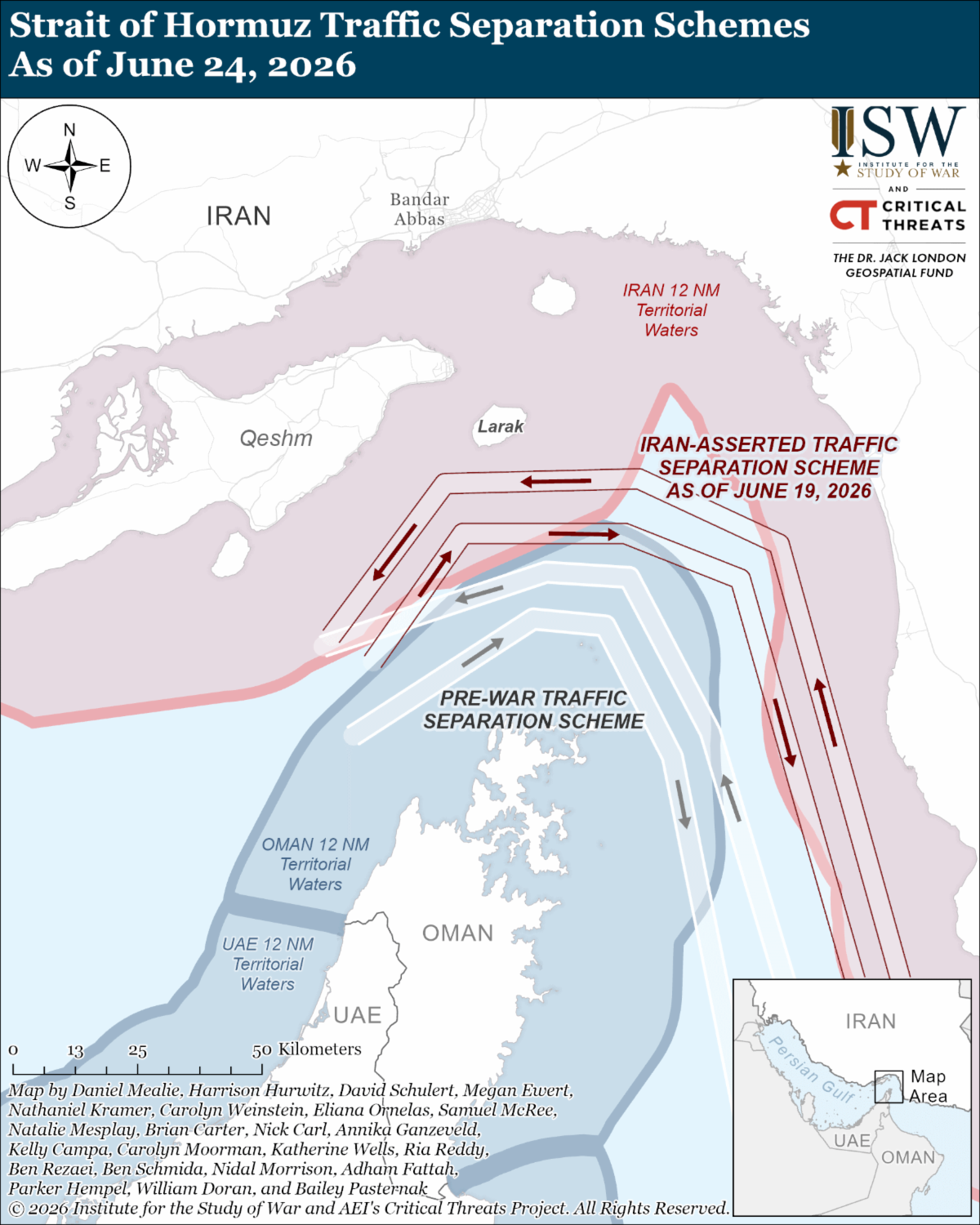
Iran is likely using discussions required by the US-Iran memorandum of understanding (MoU) to reach arrangements with the Gulf states that would allow for sustained Iranian influence around the Strait of Hormuz during the post-war period. The fifth clause of the US-Iran MoU charges Iran with discussing the future management of the Strait of Hormuz with Oman and other littoral Persian Gulf states. Iranian officials, including Iranian Parliament Speaker and chief negotiator Mohammad Bagher Ghalibaf, met with Omani officials in Muscat on June 23. Iranian Foreign Affairs Minister Abbas Araghchi also discussed strengthening regional cooperation with his Saudi counterpart, Faisal bin Farhan, on June 24. Iran is likely attempting to use these talks to segue discussions over the immediate management of the Strait of Hormuz and resumption of traffic into broader discussions about a new regional architecture in the Gulf region. Ghalibaf explicitly stated on June 24 that Iran is ready for security agreements with Gulf states “that are made sustainable through economic cooperation.” Brigadier General Esmail Ahmadi Moghaddam, who is the Supreme National Defense University President and a longtime regime insider who plays an influential role in Iranian security discourse, also highlighted Iran’s objectives to strengthen its strategic relations with its neighbors in this post-war period in a speech on June 24.
Recent remarks from Qatari Foreign Minister and Prime Minister Mohammed bin Abdulrahman al Thani suggested that some Gulf countries may be amenable to cooperating with the Iranians on a “broader economic framework.” Thani told the Financial Times on June 24 that Qatar was open to discussing Iran’s plans to administer the strait alongside Oman with other Gulf countries. Qatari officials met with Omani officials on June 24, likely to discuss Oman’s recent discussions about the strait with Iranian officials. A diplomat briefed on Thani’s visit to Muscat told Reuters that Qatari and Omani officials discussed initiating negotiations involving Iran, Iraq, and Gulf Arab states on the Strait of Hormuz. The diplomat stated that the Gulf states are planning to push for no “transit fees,” and added that Iran “could” push for environmental, navigation, and security fees in these discussions. The diplomat’s framing, in which Gulf states oppose transit fees explicitly but do not oppose other fees explicitly, implies that some Gulf states are willing to entertain fees in return for certain Iranian concessions or guarantees. Iran could weave these fees into any regional agreement over the strait’s management, for example. Thani denied that Qatar would approve any plan in which the Persian Gulf — which Thani called Qatar’s “gateway to the world” — was “controlled” or subject to a toll system. Thani did not explicitly rule out other arrangements that could still be favorable to Iran and give Iran a say in the future of the strait. A diplomat familiar with the matter told Agence France-Presse later on June 24 that Saudi Arabia is preparing to hold a “reconciliation summit” between Iran and Arab Gulf states separate from the US-Iran negotiations, but no date has been set at the time of this writing. The Strait of Hormuz is an international waterway under the UN Convention on the Law of the Sea (UNCLOS). Any effort to place the Strait under the control of a state or several states would erode long-standing international norms and maritime law. | 


No comments:
Post a Comment