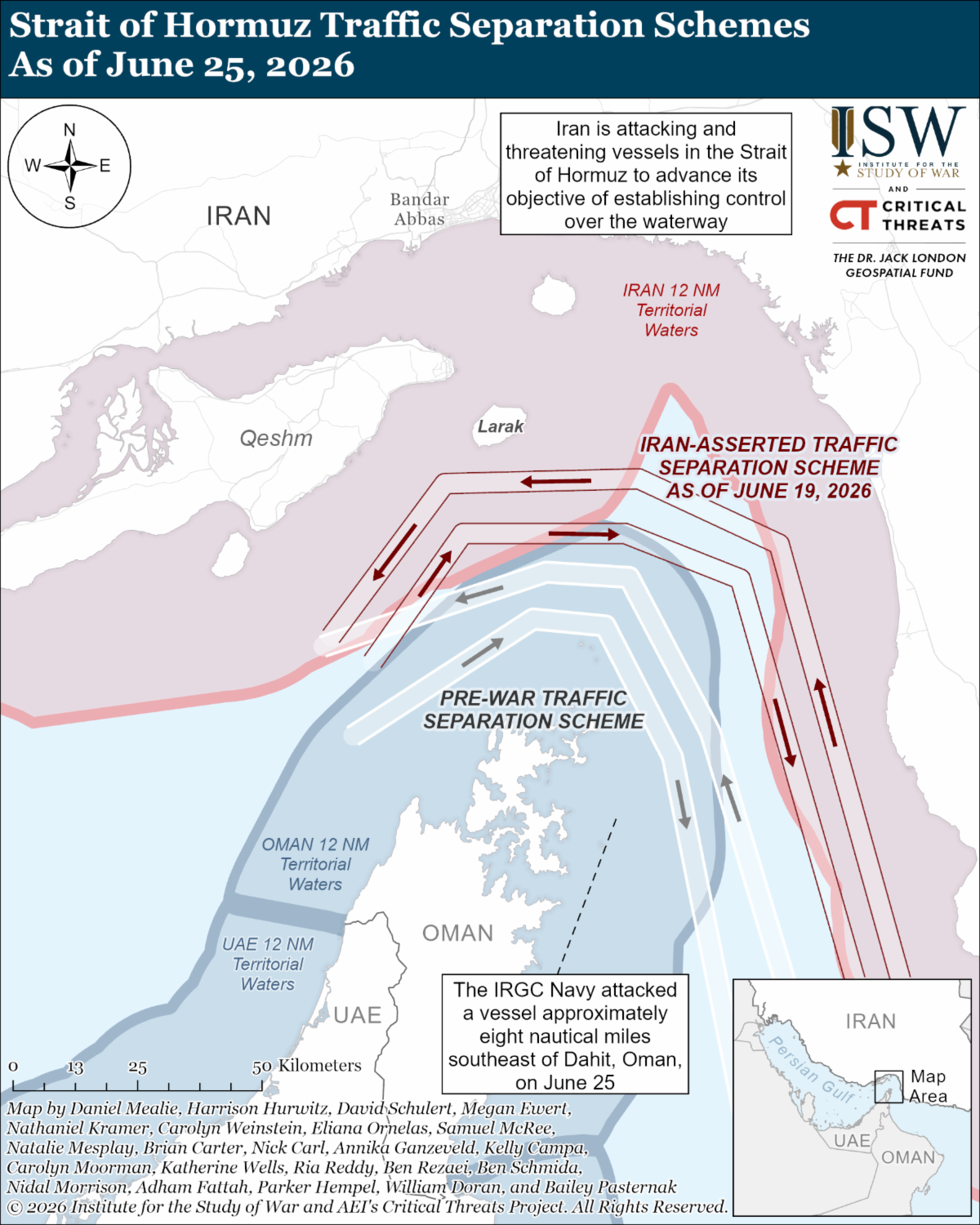
Iran is attacking and threatening vessels in the Strait of Hormuz to advance its objective of establishing control over the waterway. The Islamic Revolutionary Guards Corps (IRGC) Navy attacked a vessel approximately eight nautical miles southeast of Dahit, Oman, on June 25. The attack came after the IRGC Navy issued a warning demanding that vessels coordinate with Iranian authorities and use the Iranian-approved traffic separation scheme. The IRGC Navy warned that traffic outside these routes is “very dangerous” and implicitly threatened vessels that do not comply. Iran likely seeks to use force and coercion to compel vessels to use its illegitimate traffic separation scheme and implicitly acknowledge Iranian control over the strait, which is a key objective for the regime.
The recent attack and ongoing threats also likely seek to undermine international efforts to guarantee safe passage through the Strait of Hormuz. The International Maritime Organization (IMO) and Oman announced a joint initiative on June 23 to help hundreds of stranded vessels transit the strait through a designated safe route. The IRGC Navy criticized the initiative as “unacceptable and completely dangerous,” likely because Iran assesses that a viable transit route outside Iranian territorial waters would weaken its ability to control maritime traffic and use the strait as leverage. Commercially available maritime data indicates that at least 67 vessels transited the strait since ISW-CTP's last data cutoff. Forty-seven vessels used the IMO-Omani route along the Omani coast, while only ten used the Iranian-approved route, which illustrates how alternative transit routes may threaten Iran’s efforts to manage traffic through the strait unless Iran continues to fire on shipping or otherwise compel shipping to use its transit scheme. The IMO paused its evacuation plan following the IRGC attack on the vessel. One of the IMO’s key responsibilities is to designate safe maritime routes. Iran may calculate that attacks on vessels could discourage countries and international organizations from facilitating such alternative transit routes.
Iran is using military threats and economic incentives to try to convince Gulf states to support its efforts to control the strait, but the Gulf states appear to be resisting Iranian pressure at present. The recent Iranian threats and attacks likely serve as an implicit warning to Gulf countries—particularly Oman, given the Omani-IMO efforts described above—that Iran will continue to attack international shipping if they do not cooperate with Iran. Iran used a similar strategy during the recent US-Iran War. Iran launched hundreds of drones and missiles at Gulf states during the war in order to try to influence their decision-making to achieve Iranian objectives, which included halting US operations against Iran and driving a wedge between the United States and its Gulf allies. Iran is currently trying to diplomatically induce and militarily compel these states into cooperation. Iranian Foreign Affairs Minister Abbas Araghchi held a phone call with Omani Foreign Minister Badr al Busaidi on June 25, likely as part of this broader diplomatic effort. The US-Iran memorandum of understanding (MoU) requires Iran to coordinate with Oman and the other Gulf countries on the future management of the strait, which likely explains Iran’s efforts to do so in recent days. Iran has also offered economic incentives to attract regional support for its plans for the strait. Iranian officials told the Wall Street Journal that Iran wants Gulf states to participate in a future system that would charge vessels for services in the strait and share the revenue. Officials familiar with the proposal estimated that such fees could generate roughly 40 billion USD annually “for [the] states involved.” It is not immediately clear whether this means 40 billion USD annually split between the states involved, or 40 billion USD annually per state. | 



No comments:
Post a Comment