Islamic Revolutionary Guards Corps (IRGC)-affiliated media has made Iranian implementation of the US-Iran agreement, particularly provisions concerning the Strait of Hormuz, contingent on an end to Israeli operations against Hezbollah in Lebanon. Iran is likely connecting these two clauses to compel the United States to pressure Israel to cease operations in Lebanon. Iranian and Hezbollah-affiliated actors have suggested that the memorandum of understanding (MoU) requires both a cessation of Israeli military operations in Lebanon and a complete Israeli withdrawal from Lebanese territory. Iran reportedly pushed to add language guaranteeing the “sovereignty and territorial integrity of Lebanon” to the agreement’s opening clause, likely to strengthen its longstanding maximalist objective of securing an Israeli withdrawal from Lebanon. IRGC-affiliated Tasnim News Agency explicitly linked implementation of the agreement to developments in Lebanon, arguing that Iran should keep the Strait of Hormuz closed as long as Israel continues operations there. Tasnim further warned that Iran could suspend future negotiations, reimpose restrictions in the strait, halt the reopening process, or respond militarily to Israeli actions if the MoU is not fully implemented. These articles follow claims by senior Iranian officials and bodies, including the Khatam ol Anbiya Central Headquarters and the IRGC, that Israeli operations in Lebanon violate the MoU.
Hezbollah has twice initiated military operations against Israel since 2023 and entered wars without provocation. Hezbollah began attacking Israel on October 8, 2023, to support Hamas after it attacked Israel in the October 7 attack. Hezbollah again attacked Israel on March 1, 2026, to support Iran after US-Israeli operations began against Iran. Hezbollah seriously affects northern Israeli security, and its attacks have displaced Israeli citizens there. Israel is not a signatory to the MoU, even though the signatories added language that implied that Israel and Hezbollah were signatories. The MoU says that “the United States of America and the Islamic Republic of Iran and their allies in the current war are signing this MoU.” Iran’s threats to collapse the agreement unless Israel ceases operations and withdraws from Lebanon likely reflect a deliberate effort to compel the United States to pressure Israel to end operations. Iran has surely observed reports in Western media that President Donald Trump prioritizes preserving the deal and has pressured Israeli Prime Minister Benjamin Netanyahu to limit military operations in Lebanon.
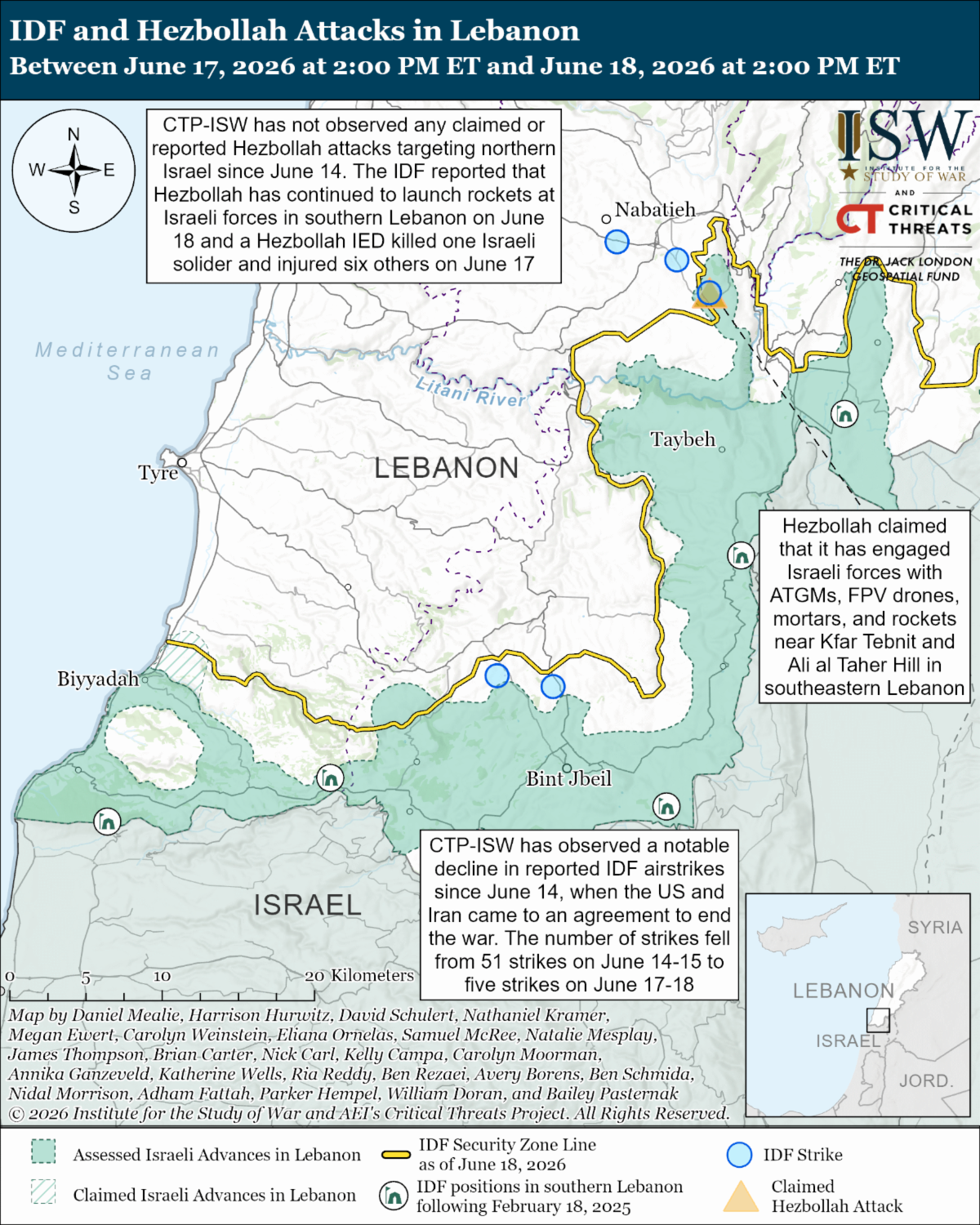
The Israel Defense Forces (IDF) has continued operations against Hezbollah in southern Lebanon, despite Iranian insistence that Israel must halt its campaign in Lebanon as part of the MoU. The IDF stated on June 18 that it will remain deployed within the 10-kilometer-deep IDF “security zone” in southern Lebanon to remove Hezbollah threats to Israeli forces in southern Lebanon and Israeli residents in northern Israel. Two Israeli officials told Reuters on June 18 that Israel recently held talks with the United States to discuss US approval for continued IDF presence in southern Lebanon. Israeli media reported on June 18 that Israeli Prime Minister Benjamin Netanyahu told US President Donald Trump during a phone call that Israel will not leave southern Lebanon “as long as Israel’s security needs require it.” Trump stated in a social media post on June 18 that the United States expects a complete ceasefire on all fronts, including in Lebanon between Hezbollah and Israel. Hezbollah, Iranian officials, and Iranian media have continued to claim that the US-Iran agreement requires Israel to cease operations against Hezbollah and ultimately withdraw from southern Lebanon. Both sides have continued to engage one another in southern Lebanon, including beyond the Yellow Line. | 


No comments:
Post a Comment