The United States and Iran signed the memorandum of understanding (MoU) on June 17. Iran is claiming that the final MoU text satisfies some of its key war aims related to Lebanon and the Strait of Hormuz. US officials briefed US media, including The New York Times, CNN, Axios, and others, on the contents of the MoU before Iran and the United States signed it. The final MoU is basically unchanged from the version provided to Bloomberg on June 16, except for text changes in clauses one and five that Iran reportedly requested. Islamic Revolutionary Guards Corps (IRGC)-affiliated Fars News reported on June 15 that Iran had earlier secured important changes to the draft MoU. These changes included the addition of the phrase “guaranteeing sovereignty and respect for the territorial integrity of Lebanon” to the first clause, references to a joint Iranian-Omani maritime services administration in the Strait of Hormuz to the fifth clause, and an addition that the MoU would bar fee collection in the strait for 60 days, also in the fifth clause. All three of these changes are reflected in the version briefed to US media but not in the earlier version leaked to Bloomberg (changes highlighted below in bold). IRGC-affiliated Tasnim News Agency noted on June 17—before the signing and the briefing to US media—that Bloomberg’s reported text was inaccurate and had “numerous flaws” related to Lebanon and the Strait of Hormuz.
Top Iranian officials are using these changes to imply that they have satisfied their key war aims of controlling the Strait of Hormuz and preserving Hezbollah. Iranian First Vice President Mohammad Reza Aref said that Iran would retain control over the Strait of Hormuz and that vessels transiting the waterway should pay service fees for safe navigation of the strait. Iran continues to be the only threat against commercial shipping in the strait. Aref said that the Strait of Hormuz “belongs to Iran” and that its management will remain Iran’s responsibility. Clause 5 indicates that Iran would need to negotiate with the Gulf Arab states to ensure its management of the strait, however, and it remains unlikely that the Gulf Arab states would acquiesce to Iranian demands without Iranian coercion. The fact that Iran can negotiate the status of an international waterway is nonetheless an erosion of long-established international law and norms enshrined in the UN Convention on the Law of the Sea (UNCLOS).
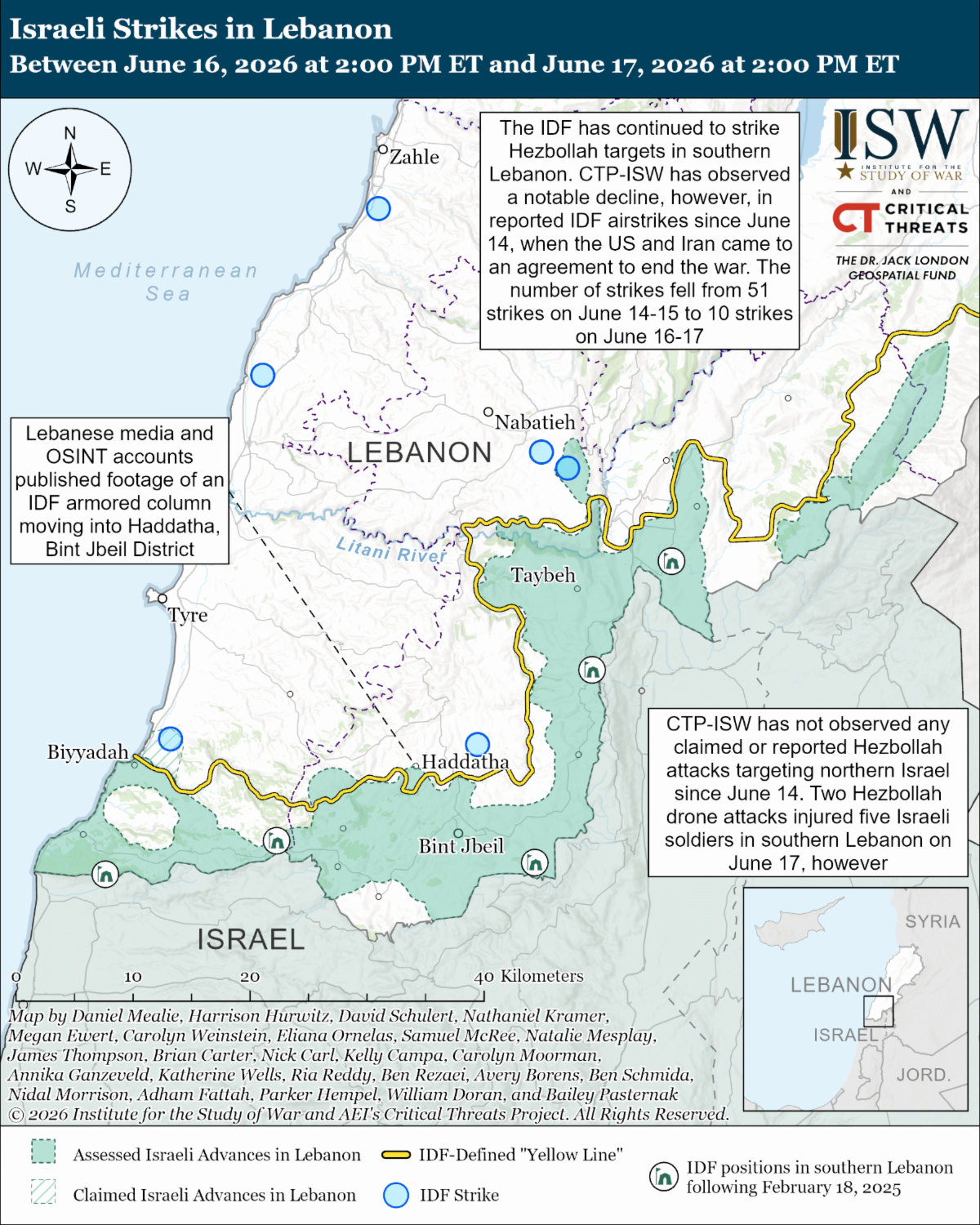
Iran also appears to believe that the MoU requires Israel to withdraw from Lebanon, which would help preserve Hezbollah. A Hezbollah source told Emirati media on June 16 that Iran told Hezbollah that the withdrawal of Israeli troops from Lebanon is included in the US-Iran MoU and is expected to occur over a phased 60-day period. The source added that the withdrawal of Israeli troops from Lebanon now depends on Israel, because Israel is not a party to the MoU and remains in Lebanon. A Lebanese political source told Emirati media on June 16 that Lebanon has received “no official guarantees” over an Israeli withdrawal and has not yet discussed the issue with US officials, which is at odds with Iranian claims that the MoU clearly requires Israel to withdraw from Lebanon. This demonstrates the degree of ambiguity inherent in this MoU and suggests that the United States and Iran have divergent views of the agreed-upon text. | 


No comments:
Post a Comment