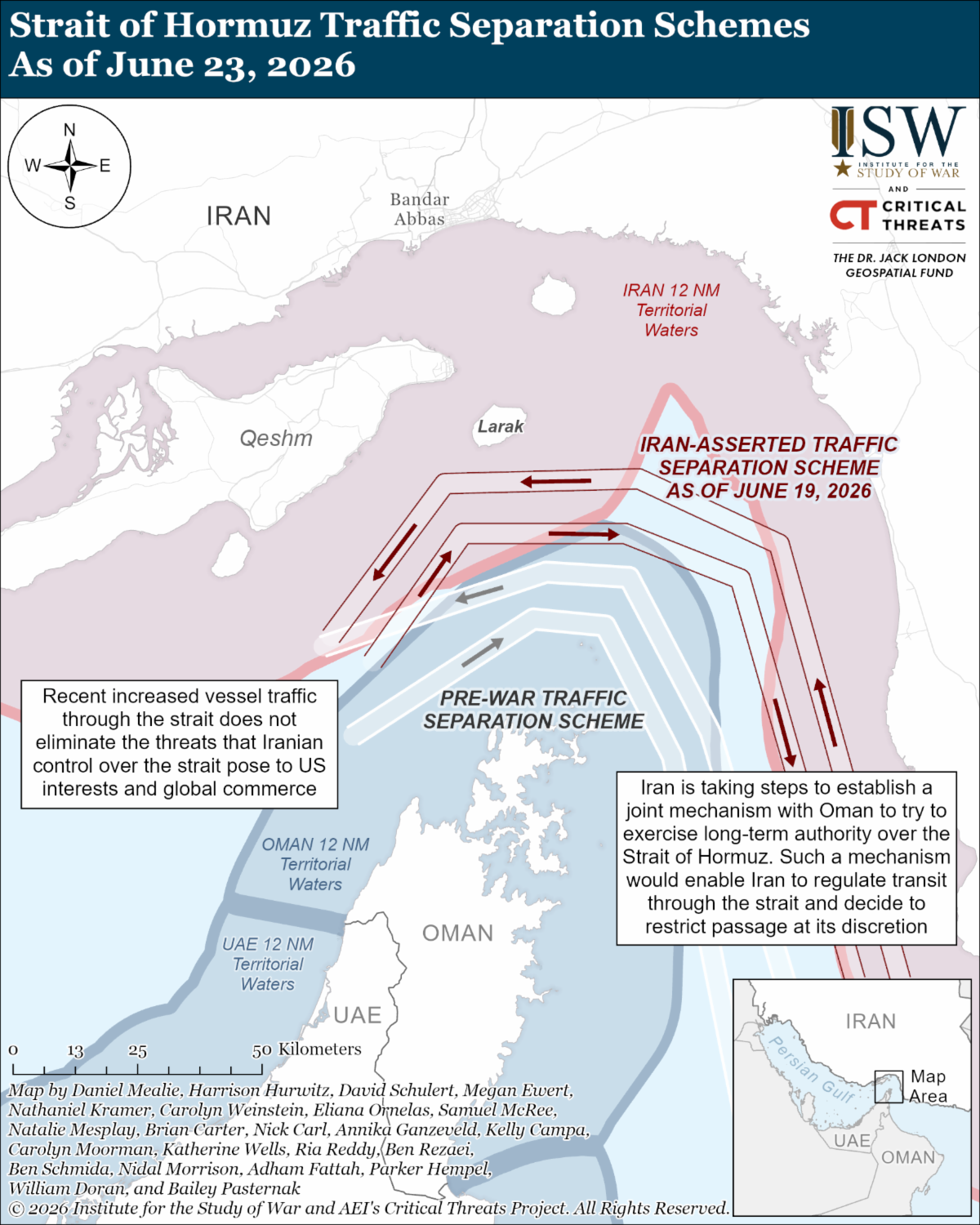
Iran is taking steps to establish a joint mechanism with Oman to try to exercise long-term authority over the Strait of Hormuz. Such a mechanism would enable Iran to regulate transit through the strait and decide to restrict passage at its discretion. Iranian Parliament Speaker Mohammad Bagher Ghalibaf met with Omani officials in Muscat on June 23 to discuss joint Iranian-Omani management of the strait. Iranian and Omani officials released a joint statement following the talks that emphasized their commitment to clause 5 of the US-Iran memorandum of understanding (MoU). This clause states that Iran will work with Oman to “define the future administration and maritime services in the Strait of Hormuz” in consultation with other Persian Gulf littoral states. Islamic Revolutionary Guards Corps (IRGC)-affiliated Fars News Agency reported that both delegations agreed to continue discussions on the management of the strait, including maritime services and associated costs. These discussions will almost certainly involve Iranian efforts to establish a toll system in which vessels must pay “service fees” to Iran and Oman to transit through the strait. Omani Foreign Affairs Minister Badr Albusaidi stated after the meeting that Oman supports “toll-free safe passage” through the strait. Iran, however, has consistently differentiated between “tolls” and other charges, such as “service fees” and “insurance” to protect vessels against attacks. Iran continues to be the only threat against commercial shipping in the strait. Any imposition of fees would violate international law. The Strait of Hormuz is an international waterway, not territorial waters, and Article 26 of the UN Convention on the Law of the Sea — which permits fees in territorial waters — therefore does not apply to the strait. A reality in which Iran is able to manage traffic through the strait and collect related fees would constitute a significant strategic victory for Iran and give Iran substantial leverage over global commerce.
Iranian regime officials have continued to deny that the United States could control how the regime spends any funds it obtains from the US-Iran memorandum of understanding (MoU). Any economic relief that the regime obtains could support Iranian efforts to reconstitute its military capabilities and the Axis of Resistance. Iranian Ambassador to the United Nations Ali Bahreini rejected on June 23 any US involvement in deciding how Iran could use unfrozen assets it gains access to from the MoU. Iran’s Central Bank Governor, Abdolnaser Hemmati, told regime media on June 23 that Iran has “no obligation” to buy US agricultural products under the terms of the MoU. US Vice President JD Vance told reporters on June 22 that, if the United States unfroze Iranian assets, Iran would have to use the assets to purchase US agricultural products. Regime officials have previously indicated that the regime could use any economic relief from the MoU to reconstitute Iran’s military capabilities. Arab mediators told the Wall Street Journal on June 13 that IRGC Commander Major General Ahmad Vahidi, whom ISW-CTP continues to assess is leading regime decision-making, has insisted that Iran’s frozen assets should not be “barred from military spending,” for example. Iranian Foreign Affairs Ministry Spokesperson Esmail Baghaei similarly stated in May that Iran would use assets released under an agreement with the United States to advance its defense and military sectors, including Iran’s missile and drone programs. | 


No comments:
Post a Comment