The Iranian regime is using information operations to magnify the informational effect of its strikes as part of an effort to compel the United States to accept an agreement that is relatively advantageous to Iran. Iran does not view the current phase in the conflict as negotiations in pursuit of a deal; it believes it is at war and that war will end with a deal. The Supreme Leader’s website argued on June 10 that Iran is “not afraid” of a ceasefire collapse, which aims to suggest to the United States that Iran does not fear a return to conflict. These messages magnify the informational effect of Iranian strikes across the region. These regional strikes are not militarily effective, but they create an informational effect by demonstrating that Iran is not concerned about going to war. This improves Iran’s position in negotiations by demonstrating to the United States that Iran is willing to resume the conflict if it does not get what it seeks in a deal — namely, control of the Strait of Hormuz, and the release of frozen funds, among other issues.
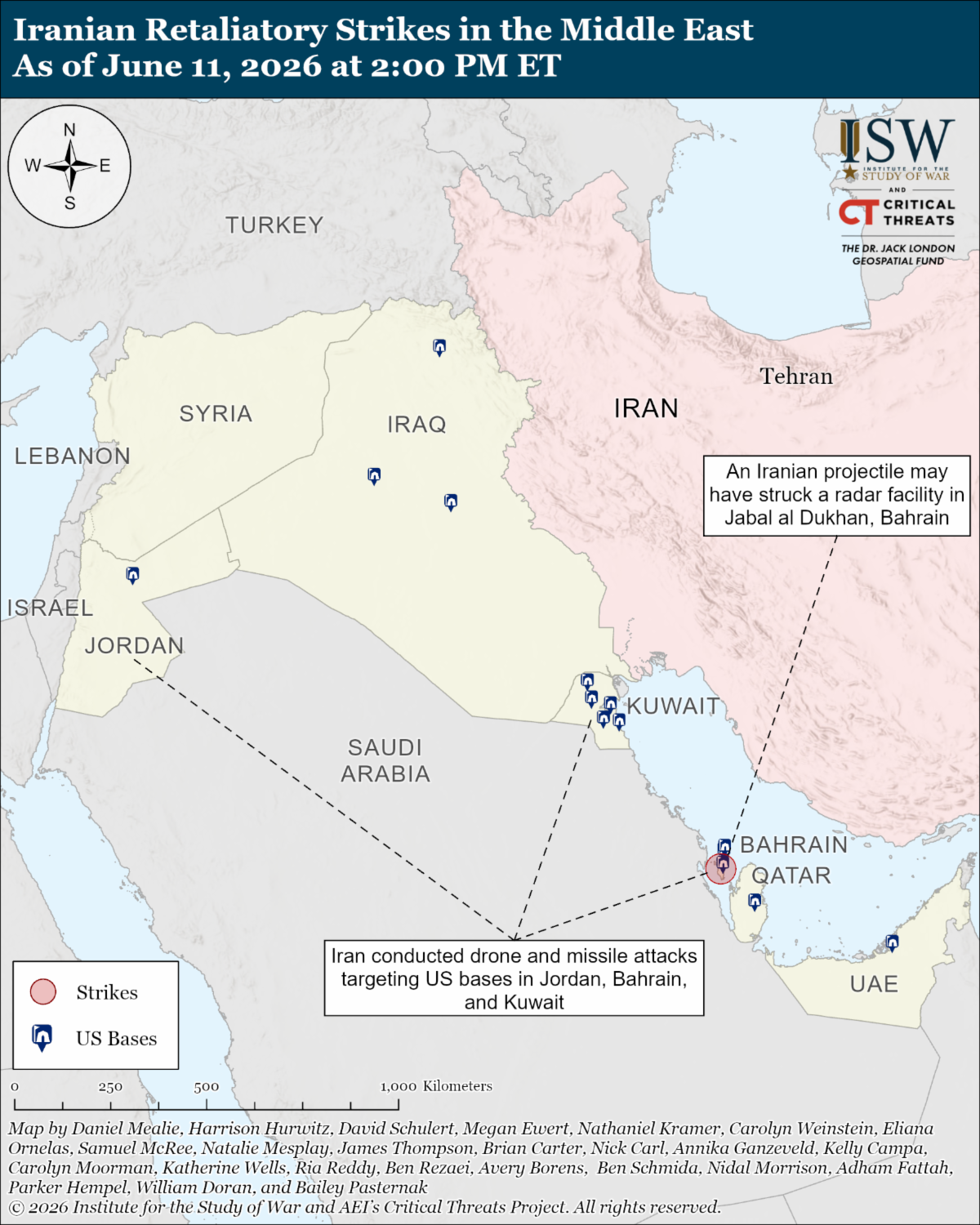
Iran’s strikes on US bases and assets are also designed to have primarily informational and economic effects, rather than military effects. Iran responded to US airstrikes targeting Iranian military capabilities on June 11 (see below for report on US airstrikes and timeline of events) with drone and missile attacks on US bases in Bahrain, Kuwait, and Jordan, as Iran had previously done on June 10. These strikes had little military effect. But the strikes appeared designed to upset markets — thereby increasing economic pressure on the United States — and trigger fears that Iran may be willing to resume the war.
The United States is attempting to degrade Iran’s ability to sense, target, and strike vessels moving through the Strait of Hormuz and US air assets protecting their transit. US Central Command (CENTCOM) announced on June 10 that US forces struck Iranian air defenses, surveillance assets, radar systems, and drone command units in southern Iran to degrade Iran’s ability to track, coerce, and attack US forces and commercial vessels in the Strait of Hormuz. Satellite imagery confirmed that US forces struck Bandar Abbas International Airport on June 10, and open-source social media users and Iranian media reported explosions across southern Iran, including Qeshm Island, Kish Island, and Minab City in Hormozgan Province near the Strait of Hormuz on June 10. The June 10 strikes followed an exchange of fire between the United States and Iran on June 9. Iran initiated the most recent escalation when an Iranian drone downed a US Apache helicopter off Oman on June 8 while it was operating over the strait. US forces also struck multiple targets on the outskirts of Tehran City, but ISW-CTP is unable to verify what these strikes targeted at this time. | 




No comments:
Post a Comment