An Iranian negotiating delegation arrived in Switzerland on June 20 to discuss the implementation of the US-Iran memorandum of understanding (MoU) with US negotiators. Iran will likely use these talks to try to pressure the United States to compel Israel to cease military operations against Hezbollah in Lebanon. Iranian Foreign Affairs Ministry Spokesperson Esmail Baghaei told Iranian state media on June 20 that the purpose of the US-Iran talks in Switzerland is to “demand the fulfillment of the [United States’] obligations,” likely referring to the regime’s position that the United States is obligated under the MoU to make Israel cease its operations against Hezbollah. Baghaei claimed that the United States has failed to implement the first clause of the MoU, which requires a ceasefire on all fronts, including Lebanon. Baghaei argued that nuclear negotiations can only take place after the United States implements this clause. Iran’s negotiating delegation includes Parliament Speaker Mohammad Bagher Ghalibaf, Foreign Affairs Minister Abbas Araghchi, Supreme National Security Council (SNSC) Deputy Secretary for International Affairs Ali Bagheri Kani, Central Bank Governor Abdolnaser Hemmati, Deputy Oil Minister and National Iranian Oil Company Chairman Hamid Bord, Deputy Foreign Affairs Minister for Legal and International Affairs Kazem Gharibabadi, and Baghaei.
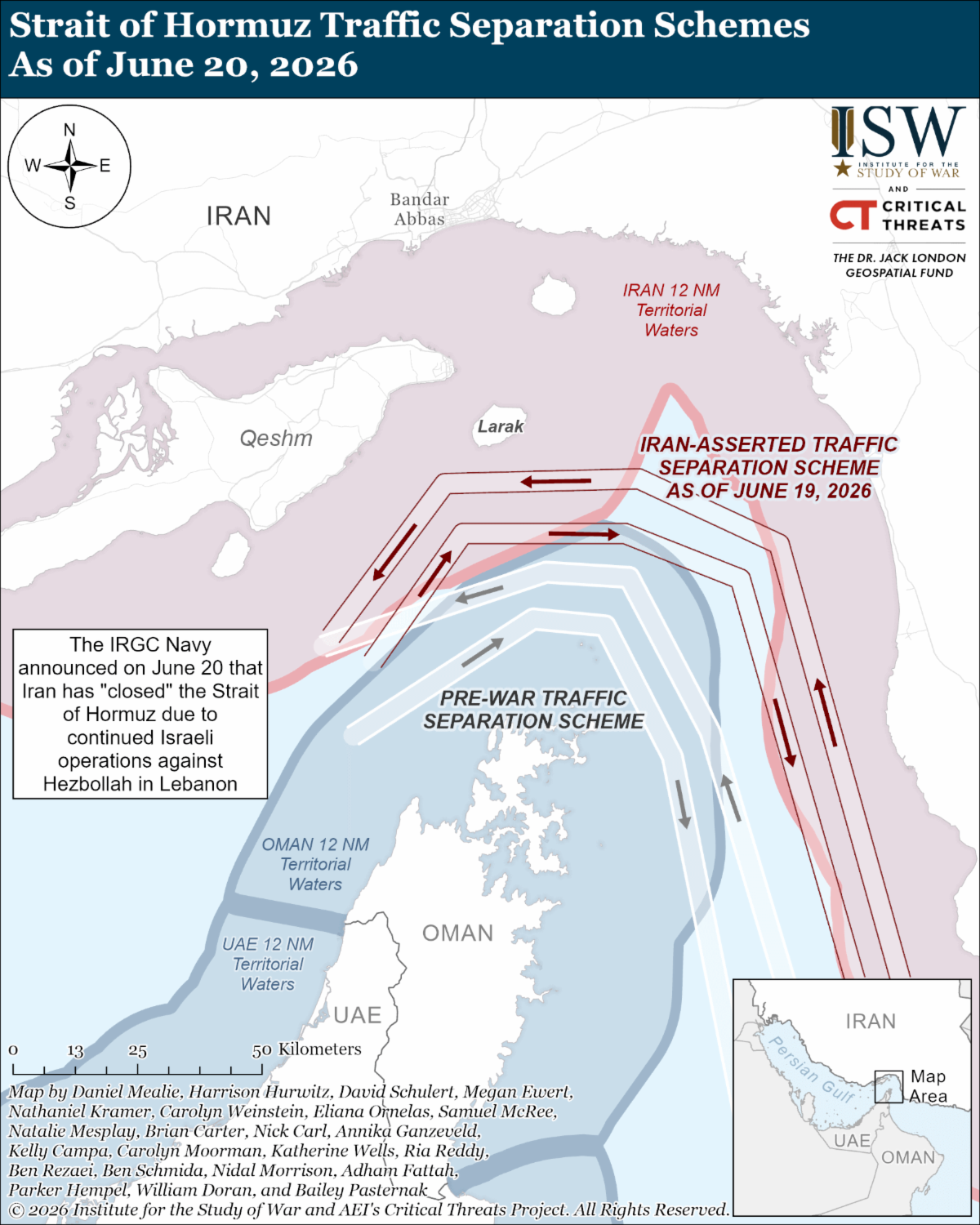
The Iranian delegation will likely use Iran’s renewed closure of the Strait of Hormuz as leverage in the talks to try to pressure the United States to compel Israel to halt operations against Hezbollah in Lebanon. Iran’s top operational headquarters, the Khatam ol Anbia Central Headquarters, and the Islamic Revolutionary Guards Corps (IRGC) Navy announced on June 20 that Iran has closed the strait until Israel stops operations in Lebanon. Iran likely calculates that it can use the strait as a tool to put greater economic pressure on the United States to meet Iranian demands. Iran has consistently sought to keep oil prices high during the conflict to put economic pressure on the United States, and Iranian officials likely recognize that announcing the closure of the strait will raise the perceived risks of shipping companies that seek to transit through the strait, which in turn drives up oil prices. US Central Command Spokesperson Captain Tim Hawkins told Axios after Iran announced the closure of the strait on June 20 that “Iran does not control the Strait of Hormuz” and that “traffic continues to flow” through the strait, however.
Israel and Hezbollah continued to launch attacks targeting each other despite agreeing to a ceasefire on June 19. Israeli Prime Minister Benjamin Netanyahu stated on June 20 that Israel will remain in the IDF security zone in southern Lebanon “as long as necessary to defend [Israel’s] northern border.” Hezbollah continues to launch rocket, drone, anti-tank guided missile, and artillery attacks targeting IDF positions in southern Lebanon. Israeli Ambassador to the United States Michael Leiter reported that Hezbollah has launched 147 rockets, 20 drones, and nine anti-tank guided missiles at Israeli forces in southern Lebanon and into Israel in the past 24 hours. The IDF announced that a Hezbollah rocket attack killed an IDF soldier and injured 13 others near Kfar Tebnit in southeastern Lebanon. IDF forces also engaged Hezbollah fighters near Ali al Taher on June 20. Netanyahu’s office reported that the IDF has struck over 300 Hezbollah targets and killed over 100 fighters in the past two days in response to Hezbollah attacks on Israeli soldiers. ISW-CTP observed a significant increase in Israeli airstrikes between June 19 and 20 compared to recent days. Netanyahu’s office and the IDF warned that it is committed to the ceasefire but will continue to “forcefully” strike Hezbollah if the group launches further attacks against Israeli forces. | 



No comments:
Post a Comment