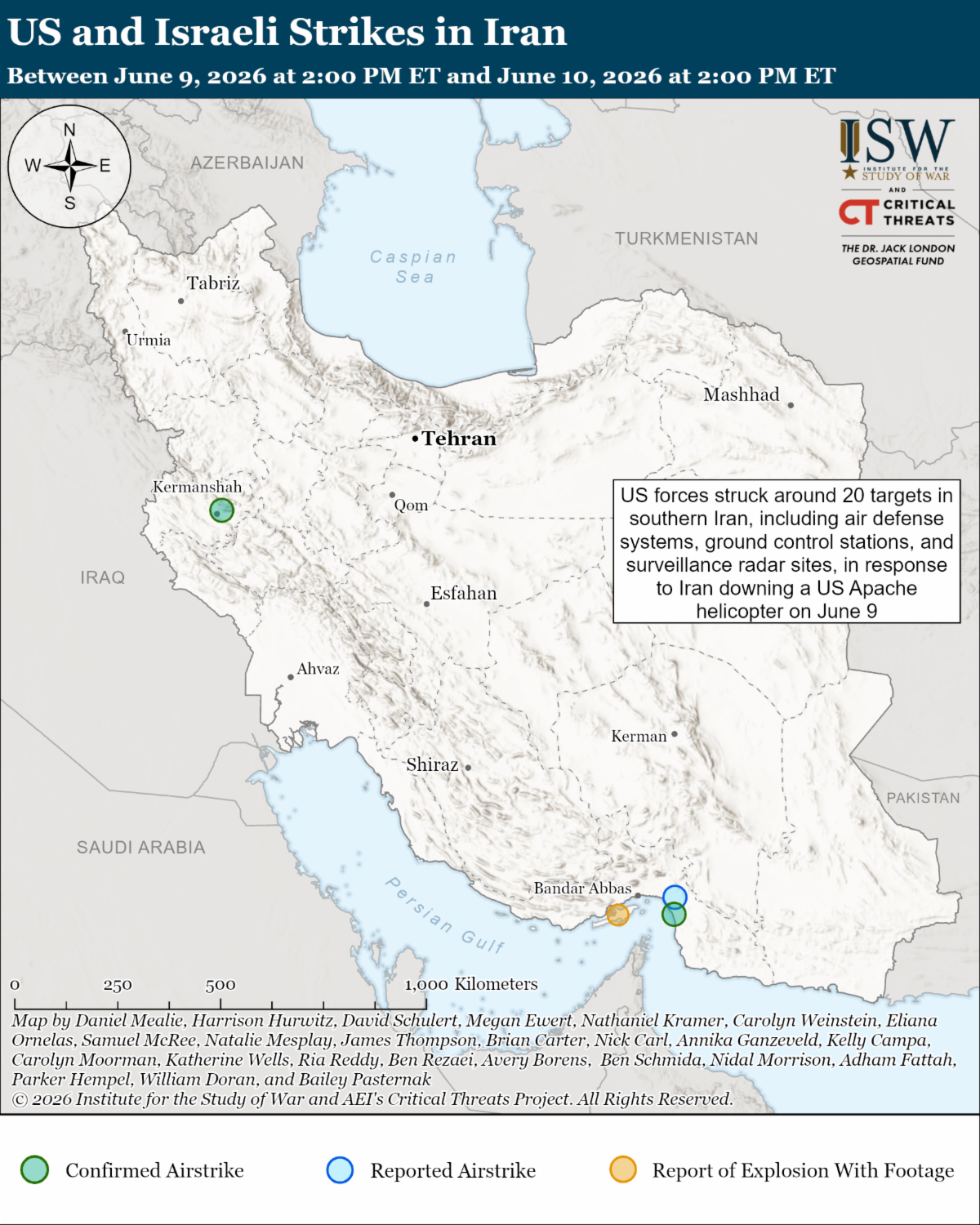
Iran is using force, combined with the threat to suspend US-Iran negotiations, to try to deter the United States from conducting further attacks on Iran that would likely make it more difficult for Iran to achieve its strategic objectives, which include solidifying control over the Strait of Hormuz and preserving the Axis of Resistance. US forces struck around 20 targets in southern Iran, including air defenses, ground control stations, and surveillance radar sites, on June 9 in response to Iran’s drone attack that downed a US Apache helicopter off the coast of Oman on June 8. Iranian forces responded by conducting several drone and missile attacks targeting US bases in Jordan, Kuwait, and Bahrain. US forces intercepted all of the projectiles except for one that landed in the vicinity of the US Navy 5th Fleet Headquarters in Manama, Bahrain, with no reported casualties at the time of this writing. The Iranian regime likely intended for these strikes to have an informational effect by signaling to the United States that Iranian forces would be prepared to resume the war with the United States if necessary. The Iranian regime likely calculated that the United States would not resume the war in response to these strikes given recent reports that US President Donald Trump would prefer a negotiated settlement over a resumption of conflict. Iranian Foreign Affairs Ministry Spokesperson Esmail Baghaei separately stated on June 10 that Iran will “review” negotiations with the United States in light of the US self-defense strikes on Iran on June 9. This comment is also part of the Iranian informational campaign aimed at deterring further US military action against Iran because Baghaei is implicitly threatening to suspend negotiations if the United States takes military action against Iran. Iran is exploiting the current situation in which it has neither made concessions in negotiations nor faces continuous large-scale strikes from the United States and Israel to advance its objectives, such as normalizing Iranian control over the Strait of Hormuz. ISW-CTP previously assessed that the Iranian regime likely calculates that the status quo is favorable to achieving its objectives.
Iran has repeatedly used calibrated force in recent weeks as part of a series of campaigns to try to achieve its strategic objectives. Iran launched missiles at Israel on June 7 to pressure US President Donald Trump to convince Israel to halt its operations against Hezbollah in Lebanon. These attacks were part of a broader Iranian effort to preserve Hezbollah, which it views as a key pillar of its deterrence strategy vis-a-vis Israel and the United States. Iran has also used force, including attacks on US forces in the Gulf and the drone attack on the Apache helicopter, to try to deter the United States from enforcing its naval blockade and interfering with Iranian efforts to control the strait. Iranian officials and media have repeatedly emphasized that Iran will not concede on control of the strait, its proxy and partner network, and its nuclear program because it views these things as central pillars to its national security strategy to deter future attacks by the United States and Israel.
ISW-CTP is monitoring reports of additional US strikes in Iran as of 5:36 PM ET on June 10. CTP-ISW will provide more details on the US strikes in its June 11 morning thread and evening update. President Trump threatened earlier on June 10 to strike Iranian power plants and bridges if Iran did not make progress in negotiations. | 



No comments:
Post a Comment