Tuesday, June 2, 2026

Institute for the Study of War - Iran Update Special Report, June 2, 2026


June 2, 2026

Data Cutoff: 2:00 PM ET

Carolyn Moorman, Ben Rezaei, Parker Hempel, Adham Fattah, and Annika Ganzeveld

TOPLINES

The Iranian regime is likely trying to transform negotiations about ending the war with Iran into negotiations about ending the war in Lebanon, which Iran and Hezbollah seek to end in Israel’s capitulation. The Iranian regime is likely also using the time it is buying through this negotiation tactic to try to legitimize its illegal traffic separation scheme in the Strait of Hormuz and solidify its de facto control over the strait. Islamic Revolutionary Guards Corps (IRGC)-affiliated media outlets reported on June 2 that Iran has not sent a response to US President Donald Trump’s amendments to the draft US-Iran memorandum of understanding (MoU) and that Iran and the United States have not exchanged messages for several days. IRGC-affiliated Fars News Agency, citing an informed source, reported on June 2 that Iran’s last message to the United States was a “clear message” about Lebanon. Iranian officials have previously conditioned further negotiations with the United States on a ceasefire in Lebanon, but Iranian officials have coalesced around and emphasized this demand to a greater degree following Trump’s request for amendments to the draft MoU, particularly amendments related to Iran’s highly enriched uranium (HEU) and the Strait of Hormuz. Iran is likely using the Lebanon issue to deflect attention from these core disputes and to protract discussions about a ceasefire in Lebanon, which buys Iran time to preserve its sources of leverage, such as its nuclear program and control over the Strait of Hormuz.


The United States mediated a partial agreement between Israel and Hezbollah to halt Israeli strikes against Beirut and Hezbollah strikes against northern Israel. The ceasefire appears to be largely holding but is very fragile. A partial ceasefire likely does not meet Iran and Hezbollah’s maximalist demand for a complete ceasefire in Lebanon, which Iran and Hezbollah view as a prerequisite for the withdrawal of Israeli forces from Lebanon. President Trump held a phone call with Israeli Prime Minister Benjamin Netanyahu on June 1 and stated that Israel agreed not to attack Beirut. The Lebanese Embassy in Washington said that the Lebanese government received confirmation from Hezbollah that the group accepted the US-mediated proposal, in which the Israel Defense Forces (IDF) would stop strikes against Beirut in exchange for Hezbollah halting attacks on Israeli territory. The embassy stated that the ceasefire “would be extended to all Lebanese territory” over an unspecified timeframe. The IDF has not struck Beirut since the US and Lebanese governments announced the partial ceasefire proposal. Hezbollah has also not claimed any attacks against northern Israel since the announcement. Israeli military correspondents reported on June 1 that Hezbollah fired two rockets and one drone at targets in northern Israel, none of which caused any casualties, however. The IDF and Hezbollah continued to launch attacks against each other in southern Lebanon on June 1 and 2, which could threaten to collapse the fragile US proposal. Israeli Prime Minister Benjamin Netanyahu and Israeli Defense Minister Israel Katz warned that the IDF would resume its planned strikes against Hezbollah infrastructure in Beirut if Hezbollah attacks northern Israeli communities.

KEY TAKEAWAYS

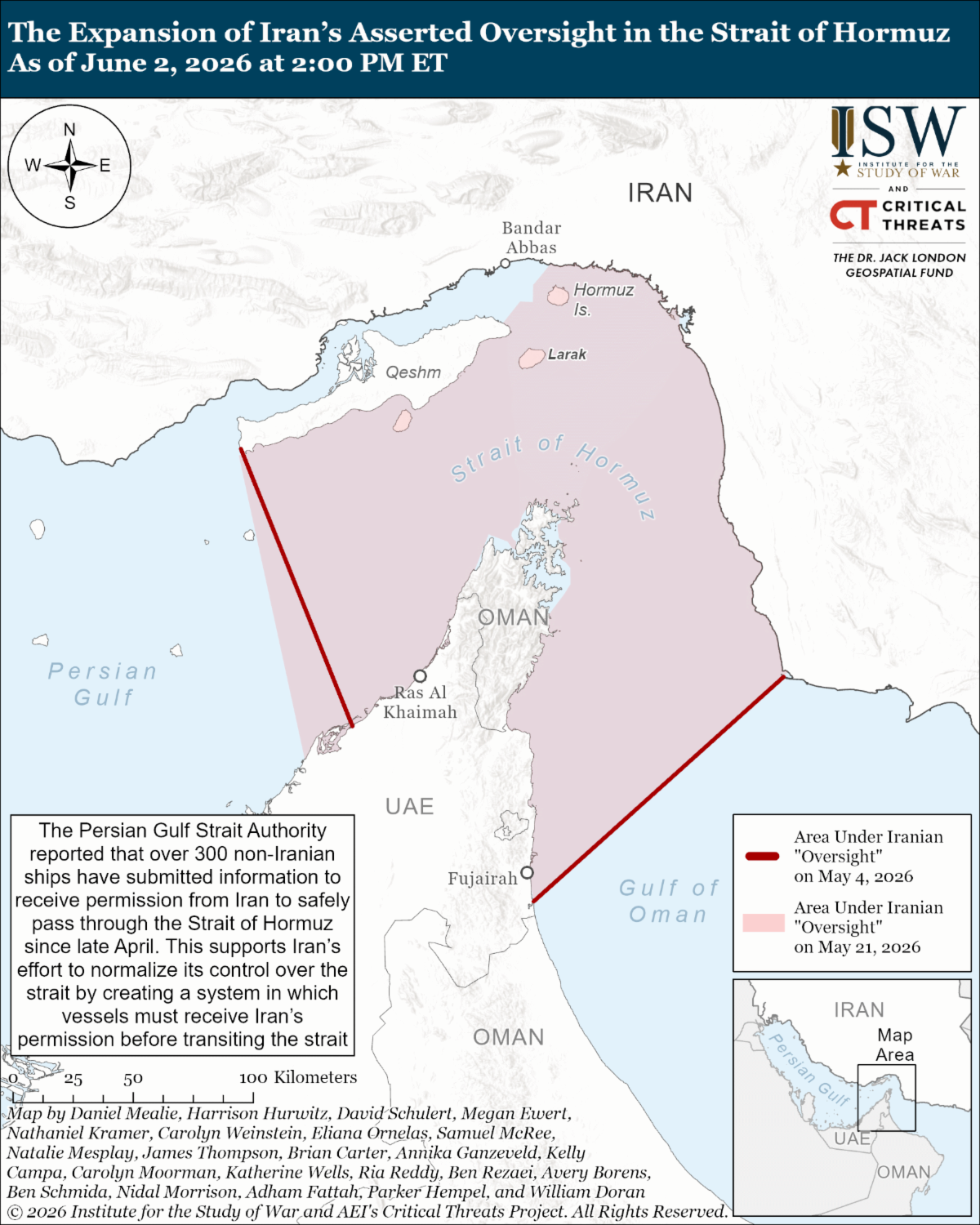
  • The Iranian regime is likely trying to transform negotiations about ending the war with Iran into negotiations about ending the war in Lebanon, which Iran and Hezbollah seek to end in Israel’s capitulation. The Iranian regime is likely also using the time it is buying through this negotiation tactic to try to legitimize its illegal traffic separation scheme in the Strait of Hormuz and solidify its de facto control over the strait.


  • The United States mediated a partial agreement between Israel and Hezbollah to halt Israeli strikes against Beirut and Hezbollah strikes against northern Israel. The ceasefire appears to be largely holding but is very fragile. A partial ceasefire likely does not meet Iran and Hezbollah’s maximalist demand for a complete ceasefire in Lebanon, which Iran and Hezbollah view as a prerequisite for the withdrawal of Israeli forces from Lebanon.


  • Iran and the Axis of Resistance are conducting an information operation that is likely intended to pressure the United States to convince Israel to halt its operations against Hezbollah in Lebanon. Iranian officials have threatened attacks against both Israel and shipping in the Bab el Mandeb Strait in response to Israeli operations in Lebanon, likely because they calculate that the threat of an expanded conflict will drive the United States to pressure Israel to stop its operations against Hezbollah.


  • Iran is also using the time it is gaining by deflecting attention from the US-Iran negotiations to advance other objectives, such as securing Iranian control over the Strait of Hormuz. The IRGC Navy announced on June 2 that it permitted 24 vessels to pass through the strait in the past 24 hours.


  • The Iraqi Shia Coordination Framework announced its support on June 1 for restricting arms to the state and separating the Iranian-backed Popular Mobilization Forces (PMF) from all “political, partisan, and social frameworks.” The framework’s announcement is probably a response to intensified US pressure on the Iraqi federal government to disarm the militias, rather than an indicator that the framework intends to disarm the militias.


  • Iranian-backed Iraqi militia Asaib Ahl al Haq announced on June 2 that it has formed an internal committee to begin “disengaging” from the PMF. This announcement comes amid Asaib Ahl al Haq leader Qais al Khazali’s public support for disarmament and shift toward political activity in recent years.

ISW takes no US or foreign government funding.

We are powered by the support of individuals like you.

Help us stay independent and impactful.

Website | Jobs | Internships


Follow ISW on social media:


Facebook | X | YouTube | Instagram | LinkedIn | Threads | Bluesky

© 2026 Institute for the Study of War and AEI’s Critical Threats Project. All rights reserved.


Donate online or by sending a check to the Institute for the Study of War at 1400 16th Street NW, Suite #515, Washington, DC 20036. Please consider including the Institute for the Study of War in your estate plans.


ISW is a tax-exempt organization under section 501(c)(3) of the Internal Revenue Code. Donations are tax-deductible to the extent permitted by law.


ISW is a non-partisan, non-profit, public policy research organization. ISW advances an informed understanding of military affairs through reliable research, trusted analysis, and innovative education. We are committed to improving the nation's ability to execute military operations and respond to emerging threats in order to achieve US strategic objectives.

No comments:

Post a Comment