Wednesday, May 20, 2026

The Institute for the Study of War -Iran Update Special Report, May 20, 2026


May 20, 2026

Data Cutoff: 2:00 PM ET

Ria Reddy, Adham Fattah, Will Doran, Parker Hempel, Carolyn Moorman, Nidal Morrison, Katherine Wells, and Brian Carter 

As the Middle East crisis evolves, ISW urgently needs your support.

Help us stay independent and impactful.

TOPLINES

Iran is likely using the ceasefire period to normalize Iranian control over the Strait of Hormuz by compelling oil-importing countries to establish a bilateral transit agreement with Iran while charging fees from vessels that are not part of the bilateral deals. The transit agreements and fee system use a multi-tiered system, according to Iranian officials speaking to Reuters on May 20. Iranian strategic partners, like Russia and China, are prioritized at the top tier, while countries with close ties to Iran, like India and Pakistan, can operate within negotiated transit agreements. Other countries are handled on a case-by-case basis, and any vessel that has links to Iranian adversaries is denied access entirely. Finally, ships that do not fall under a bilateral agreement are required to pay fees, which are reportedly around $150,000. The Iranian Islamic Revolutionary Guards Corps (IRGC) runs the scheme. These fees are framed as “security” fees, but the fees are in reality part of a mafia-esque protection racket in which the vessels pay Iran so that the Iranian navy can “secure” the vessels against an attack by the Iranian navy or Iranian shore-based missiles and drones.


A successful Iranian effort to normalize this structure would gradually increase the number of vessels moving through the strait to near pre-war levels. This reduces the visible economic costs of restricted access and therefore weakens the primary argument for mobilizing US allies to help reopen the strait. Such a decrease in the price of oil would be reliant on a number of other factors, including market reactions and the risk calculus of the shipping companies involved. It is unclear how long a decrease would take, and Iranian efforts to normalize control would need to bear fruit before any mobilization against Iranian activities in the strait. A NATO official told Bloomberg on May 19, for example, that at least some European countries are concerned about the economic consequences of the strait’s closure, and some European states support an effort to reopen the strait if the situation fails to change by July 2026. This creates a clear incentive for Iran to normalize traffic flows under its own framework before external pressure from the United States and its allies intensifies.

KEY TAKEAWAYS

  • Iran is likely using the ceasefire period to normalize Iranian control over the Strait of Hormuz by compelling oil-importing countries to establish a bilateral transit agreement with Iran while charging fees from vessels that are not part of the bilateral deals. These fees are framed as “security” fees, but the fees are in reality part of a mafia-esque protection racket in which the vessels pay Iran so that the Iranian navy can “secure” the vessels against an attack by the Iranian navy or Iranian shore-based missiles and drones.  


  • Iran’s normalization scheme could not be disrupted by a post-war “security” deployment by European states, as some countries have suggested. Iran would likely attempt to stop, perhaps with force, any post-war “security force” if the war ends with an official or de facto recognition of Iranian sovereignty over the Strait.


  • A successful Iranian effort to normalize this structure would gradually increase the number of vessels moving through the strait to near pre-war levels. This reduces the visible economic costs of restricted access and therefore weakens the primary argument for mobilizing US allies to help reopen the strait. It is not a given that this effort will be successful, however.


  • Three US officials told the Wall Street Journal that US forces seized a US-sanctioned, Iranian-linked oil tanker, the M/T Skywave (IMO: 9328716), between May 19 and 20 after it transited the Strait of Malacca on May 14. US Marines separately boarded the Iranian-flagged oil tanker M/T Celestial Sea (IMO: 9397030) on May 20 on suspicion of attempting to reach an Iranian port.


  • The Islamic Revolutionary Guards Corps (IRGC) threatened on May 20 to expand the war “far beyond the region” if US-Israeli strikes on Iran resume. This threat almost certainly seeks to deter renewed US-Israeli strikes but could also reflect IRGC planning for a potential future conflict. Iran does possess several capabilities with which it could operationalize these threats, including by conducting terror attacks abroad, disrupting shipping in other chokepoints, or firing ballistic missiles at longer range.


  • Pakistan is attempting to secure its own political and security interests by fulfilling its end of the Pakistan-Saudi Arabia defense agreement and helping mediate between the United States and Iran.


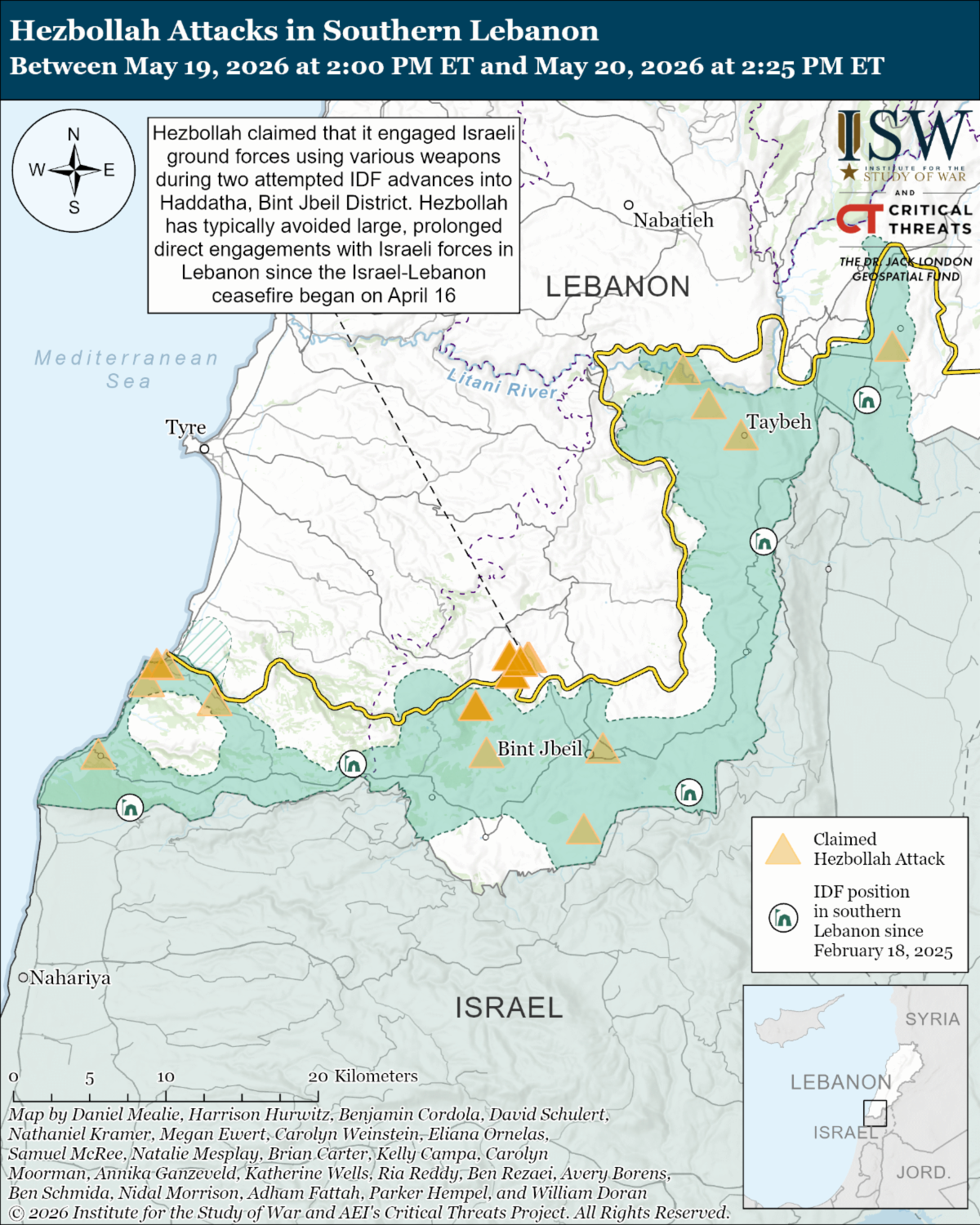
  • Hezbollah defended against an IDF assault into Haddatha, Bint Jbeil District, on May 19 and 20. The protracted Hezbollah defense is the first prolonged engagement between the IDF and Hezbollah since the ceasefire began.

Website | Jobs | Internships


Follow ISW on social media:


Facebook | X | YouTube | Instagram | LinkedIn | Threads | Bluesky

© 2026 Institute for the Study of War and AEI’s Critical Threats Project. All rights reserved.


Donate online or by sending a check to the Institute for the Study of War at 1400 16th Street NW, Suite #515, Washington, DC 20036. Please consider including the Institute for the Study of War in your estate plans.


ISW is a tax-exempt organization under section 501(c)(3) of the Internal Revenue Code. Donations are tax-deductible to the extent permitted by law.


ISW is a non-partisan, non-profit, public policy research organization. ISW advances an informed understanding of military affairs through reliable research, trusted analysis, and innovative education. We are committed to improving the nation's ability to execute military operations and respond to emerging threats in order to achieve US strategic objectives.

No comments:

Post a Comment