Iran may be prioritizing upholding the “legitimacy” of its claims to the Strait of Hormuz over toll collection at this time. This prioritization helps Iran encourage states to implicitly recognize its control over the strait while avoiding international concerns over paying the Iranians and incurring sanctions risk. Legitimizing any aspect of Iranian control over the strait, with or without tolls, is unacceptable due to the precedent it sets. Iran has touted its ability to charge tolls on ships transiting the Strait of Hormuz, but it remains unclear how many vessels have paid the tolls. Lloyd’s List reported in late March 2026 that “at least” two vessels paid the toll in Yuan, but Iranian officials on April 16 noted that no tolls had been collected. Iran only announced it received its first toll payment on April 23. Iran also appears to be providing toll exemptions for so-called “friendly” countries, which implies that a set of state behaviors approved by Iran is sufficient to avoid tolls on vessels bound for a state’s ports. Iranian Foreign Minister Abbas Araghchi said on March 26 that the People’s Republic of China (PRC), Russia, India, Iraq, and Pakistan were “friendly” states, and their vessels could pass through the strait. Others, like Malaysia and Thailand, have separate deals that permit them to travel through the strait. Most of these states, including India, Russia, Malaysia, Pakistan, and Thailand, are not subject to fees. Japanese Prime Minister Sanae Takaichi announced on May 14 that she also negotiated with Iran the safe passage of a Japanese-managed oil tanker through the strait without paying a toll. Iranian regime-affiliated media reported on May 14 that at least six Chinese vessels also safely passed through the strait, although it is unclear whether they had to pay a toll. All of these countries notably have relatively friendly relationships with Iran, including Japan, which has long acted as a mediator between Iran and the United States. The decision by Tehran to exempt so-called ”friendly” countries suggests that Iranian officials decided to prioritize encouraging states to follow its transit protocols by lifting fees, which, by implication, confers legitimacy and recognition upon Iran’s claims of sovereignty over the Strait of Hormuz.
Iran is likely prioritizing the implementation of the protocol over the tolls at this time in order to present itself as a reasonable actor that is willing to “open” the strait to “free” travel without tolls. Recognizing Iran’s protocol — which bars certain countries from accessing the strait and not others based on their behavior — is unacceptable because it implies that the Strait of Hormuz is sovereign Iranian territory. The PRC only explicitly opposes the toll system and Iranian “blockade,” but has not explicitly opposed Iranian claims to sovereignty, for example. The Strait of Hormuz is an international waterway. Recognizing Iran’s claims to the strait now will enable it to change which countries it deems as “hostile” and bar access selectively and for any reason. It is not a given, for example, that Iran would recognize the United Kingdom or France as “friendly” countries, for example, given their participation in sanctions against Iran.
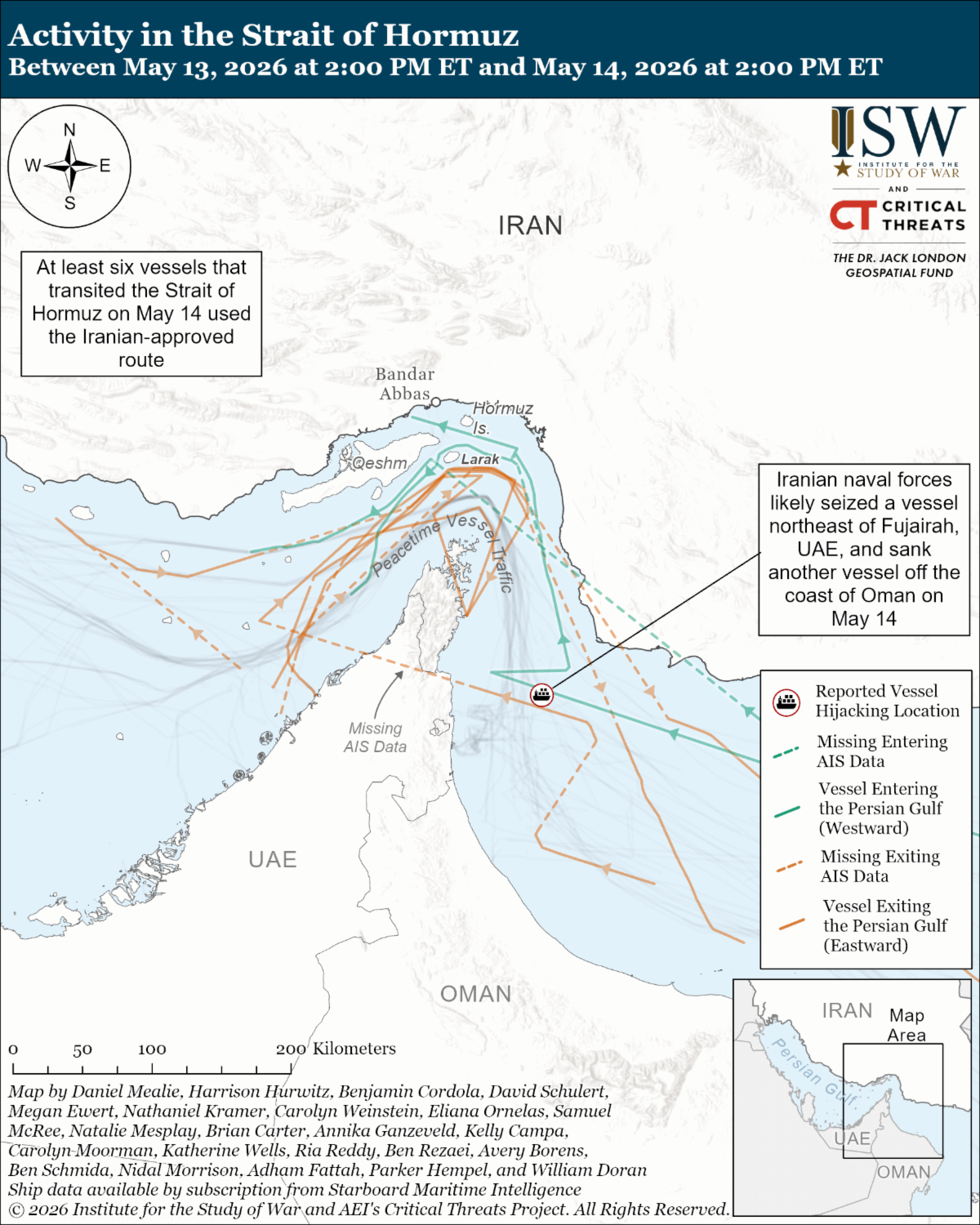
Iran has continued to enforce its protocols in the Strait of Hormuz by attacking ships. United Kingdom Maritime Trade Operations (UKMTO) reported on May 14 that likely Iranian forces seized the Honduras-flagged Hui Chuan 38 nautical miles northeast of Fujairah, United Arab Emirates (UAE), and moved it towards Iranian territorial waters. Reuters reported on May 14 that Iran likely sank an Indian cargo vessel off the coast of Oman in the Strait of Hormuz region that was traveling from Somalia to the UAE. Iranian Foreign Affairs Minister Abbas Araghchi stated on May 14 that Iran considers the strait open for all commercial vessels but that they must “cooperate” with Iranian naval forces. Allowing Iran to continue enforcing these protocols would be detrimental to US and international commercial interests, as it would mean Iran could prevent ships from traversing the strait anytime it wants. | 


No comments:
Post a Comment