Wednesday, May 27, 2026

Institute for the Study of War - Iran Update Special Report, May 27, 2026


May 27, 2026

Data Cutoff: 2:00 PM ET

Ria Reddy, Ben Rezaei, Adham Fattah, Nidal Morrison, Carolyn Moorman, and Annika Ganzeveld

TOPLINES

Senior Iranian officials continue to frame Iranian control over the Strait of Hormuz as a strategic necessity and core element of Iranian deterrence against the United States and Israel. Supreme Leader Adviser Ali Akbar Velayati described the strait on May 27 as Iran’s “ultimate leverage” and the “real guarantee” of a US-Iran agreement’s “survival.” Velayati’s remarks may reflect the Iranian regime’s belief that Iran’s ability to threaten international shipping and energy markets would make the United States less willing to withdraw from any potential agreement or conduct further military operations against Iran. Velayati’s comments reflect the degree to which senior Iranian leaders are coalescing around the notion of Iranian control over the strait as a key pillar of leverage. His comments are also consistent with ISW-CTP’s assessment that Iran views control of the strait as essential to rebuilding deterrence against the United States and Israel after the degradation of Iran’s other deterrent capabilities, particularly Iran’s ballistic missile capabilities.


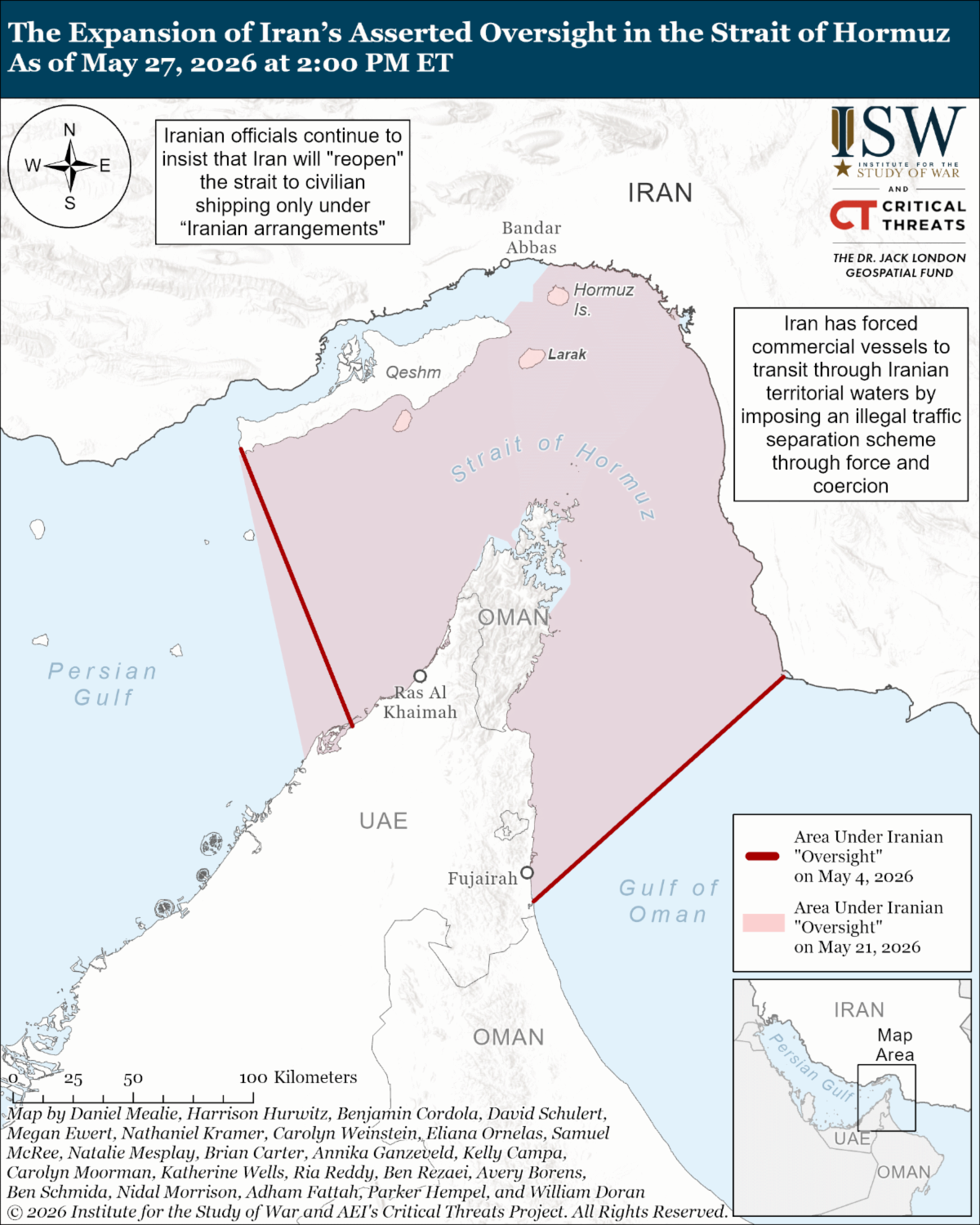
Iranian officials continue to insist that Iran will “reopen” the strait to civilian shipping under “Iranian arrangements,” which reflects the broader Iranian effort to institutionalize control over traffic through the waterway and directly contradicts the US demand for freedom of navigation. Iranian media circulated a reported draft US-Iran agreement in which Iran would “restore” shipping through the strait while continuing to manage maritime traffic jointly with Oman. The reported draft proposal also stipulates that military vessels would be barred from transiting through the strait. Iran has not explicitly barred military vessels from passing through the strait in past draft proposals, but Iranian officials and media have repeatedly publicly stated this restriction. The United States rejected the draft proposal in Iranian media as a “complete fabrication,” but the circulation of the proposal in Iranian media nevertheless reflects Iran’s continued effort to secure recognition of its sovereignty over the strait in any agreement with the United States. Iran has used naval mines and attacks on commercial vessels to force vessels to transit through Iran’s illegal and unrecognized traffic separation scheme in Iranian territorial waters, effectively forcing vessels to recognize Iran’s control of the strait. Iranian officials have cited the UN Convention on the Law of the Sea to attempt to justify charging vessels a fee for transiting through Iranian territorial waters. These vessels are not only coerced into using Iran’s traffic separation scheme, but the fees that they pay to Iran are part of an Iranian protection racket in which vessels pay to avoid Iranian attacks. Any arrangement in which maritime traffic can only pass through Iran’s traffic separation scheme with Iranian approval contradicts the US demand for freedom of navigation, and such an arrangement would significantly undermine US interests and establish a dangerous precedent for the freedom of navigation in international waterways. US President Donald Trump emphasized on May 27 the importance of freedom of navigation through the strait and stated that “nobody is going to control” the strait.


KEY TAKEAWAYS

  • Senior Iranian officials continue to frame Iranian control over the Strait of Hormuz as a strategic necessity and core element of Iranian deterrence against the United States and Israel.


  • Iranian officials continue to insist that Iran will “reopen” the strait to civilian shipping under “Iranian arrangements.” Any arrangement in which maritime traffic can only pass through Iran’s traffic separation scheme with Iranian approval contradicts the US demand for freedom of navigation, and such an arrangement would significantly undermine US interests and establish a dangerous precedent for the freedom of navigation in international waterways.


  • Conflicting reports about the draft US-Iran agreement, as well as public statements from both sides, highlight continued disagreements on other key issues between the United States and Iran. Iran’s proposed sequencing of concessions would require the United States to surrender key sources of leverage before negotiations over Iran’s nuclear program begin, which would significantly reduce US leverage in any future nuclear negotiations.


  • Iranian media outlet Nour News published an op-ed that emphasized the need for Iran to convert its recent “military victory” into broader political success, which reflects a belief within the regime that Iran emerged from the recent conflict in a position of strength. Iran’s maximalist and uncompromising negotiating positions reflect the Iranian regime’s effort to translate its perceived success in the war into long-term strategic and political gains.


  • An Israeli open-source intelligence analyst posted satellite imagery that shows Iranian reconstitution efforts at the Yazd Missile Base in Yazd Province since the start of the US-Iran ceasefire in April 2026. These reconstitution efforts corroborate ISW-CTP’s assessment that Iran is exploiting the ceasefire period to reconstitute its military capabilities at the tactical and operational levels.

ISW takes no US or foreign government funding.

We are powered by the support of individuals like you.

Help us stay independent and impactful.

Website | Jobs | Internships


Follow ISW on social media:


Facebook | X | YouTube | Instagram | LinkedIn | Threads | Bluesky

© 2026 Institute for the Study of War and AEI’s Critical Threats Project. All rights reserved.


Donate online or by sending a check to the Institute for the Study of War at 1400 16th Street NW, Suite #515, Washington, DC 20036. Please consider including the Institute for the Study of War in your estate plans.


ISW is a tax-exempt organization under section 501(c)(3) of the Internal Revenue Code. Donations are tax-deductible to the extent permitted by law.


ISW is a non-partisan, non-profit, public policy research organization. ISW advances an informed understanding of military affairs through reliable research, trusted analysis, and innovative education. We are committed to improving the nation's ability to execute military operations and respond to emerging threats in order to achieve US strategic objectives.

No comments:

Post a Comment