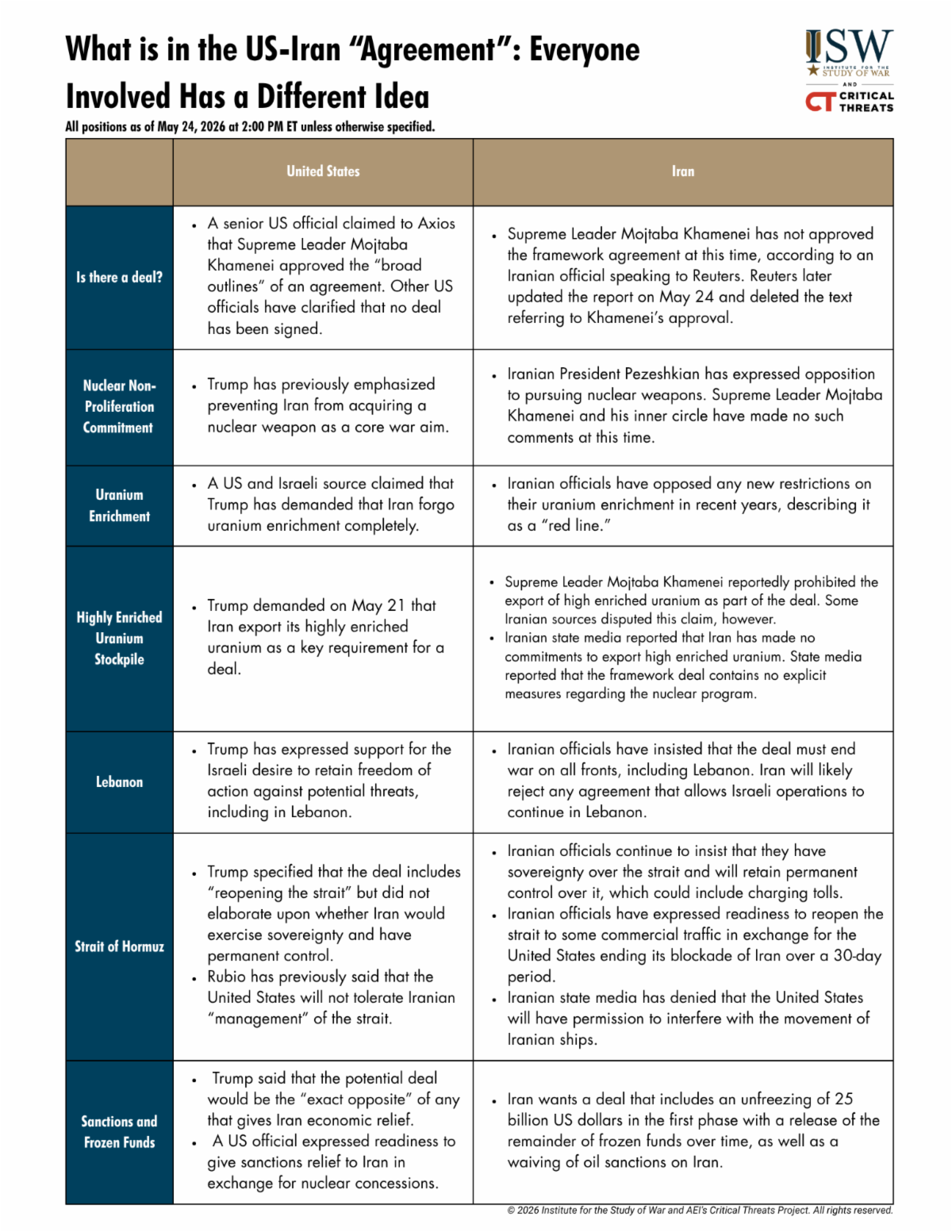
Conflicting US, Iranian, and regional reporting indicates that the contours of a possible US-Iran memorandum of understanding (MOU) remain unresolved and may not yet represent a final agreement. US President Donald Trump stated on May 23 that a deal to end the war had been “largely negotiated” and awaited finalization. A senior US official stated in a briefing with reporters on May 24 that the White House does not expect an agreement on May 24 and believes Iranian leadership, including Supreme Leader Mojtaba Khamenei, may need several days to approve the deal. An unspecified senior US official told Axios that the United States is in a “very good place” but that the parties are still negotiating specific language and that “whether this becomes an agreement is still an open question.” Trump separately stated on May 24 that a possible Iran deal “isn’t even fully negotiated yet,” while stating that any agreement would not give Iran “a clear and open path to a Nuclear Weapon.” Trump later stated that negotiations are proceeding in an “orderly and constructive manner,” but added that he had instructed his representatives ”not to rush into a deal” because time is on the US side. Trump also stated that the US naval blockade ”will remain in full force and effect” until an agreement is “reached, certified, and signed.”
Iranian officials, Islamic Revolutionary Guards Corps (IRGC)-affiliated outlets, and Iranian sources speaking to Western and regional media are presenting the possible MOU as conditional on US concessions and continued Iranian leverage. An unspecified senior Iranian official told Reuters on May 24 that the Supreme National Security Council (SNSC) will convene to approve or reject the current draft and will send it to Mojtaba for final approval if the SNSC approves it. An unspecified senior Iranian source separately told CNN that recent mediated talks have made “a lot of progress” and could mark a “turning point” toward ending the war and creating a “new era of stability and prosperity” in the region. IRGC-affiliated Tasnim News Agency reported on May 24 that disputes over one or two provisions remain unresolved due to US “obstruction” and that the MOU could still fall through if the United States does not meet Iranian demands. US “obstruction” in this context probably refers to US insistence on legitimate demands that the Iranians oppose. IRGC-affiliated reporting has identified frozen assets, sanctions relief, the naval blockade, Lebanon, and the Strait of Hormuz as the main unresolved issues. This is every issue in the first stage of the agreement, before talks on the nuclear program. Tasnim reported that an informed source said Iran will not accept any understanding without the release of a “specified portion” of Iran’s blocked assets in the first step and a clear mechanism to guarantee continued access to all blocked assets. A well-informed Iranian source told an Al Jazeera journalist on May 24 that the two central issues involve the mechanism for unfreezing Iranian assets and the scope of a Lebanon ceasefire. The source added that Iran rejected a Pakistani proposal to move ahead with agreed provisions while postponing unresolved ones.
IRGC-affiliated messaging in domestic Iranian media has said that Iran will stick to its redlines, while quotes from unspecified Iranian officials in Western media have sought to portray the talks in a positive light by describing “progress.” Unspecified Iranian officials speaking to Western outlets have described progress and an internal approval process through the SNSC and Mojtaba, which suggests that some Iranian officials want to present the draft as a viable diplomatic path. IRGC-affiliated outlets, however, have emphasized red lines, US “obstruction,” blocked assets, sanctions relief, and continued Iranian control over the Strait of Hormuz. | 


No comments:
Post a Comment